


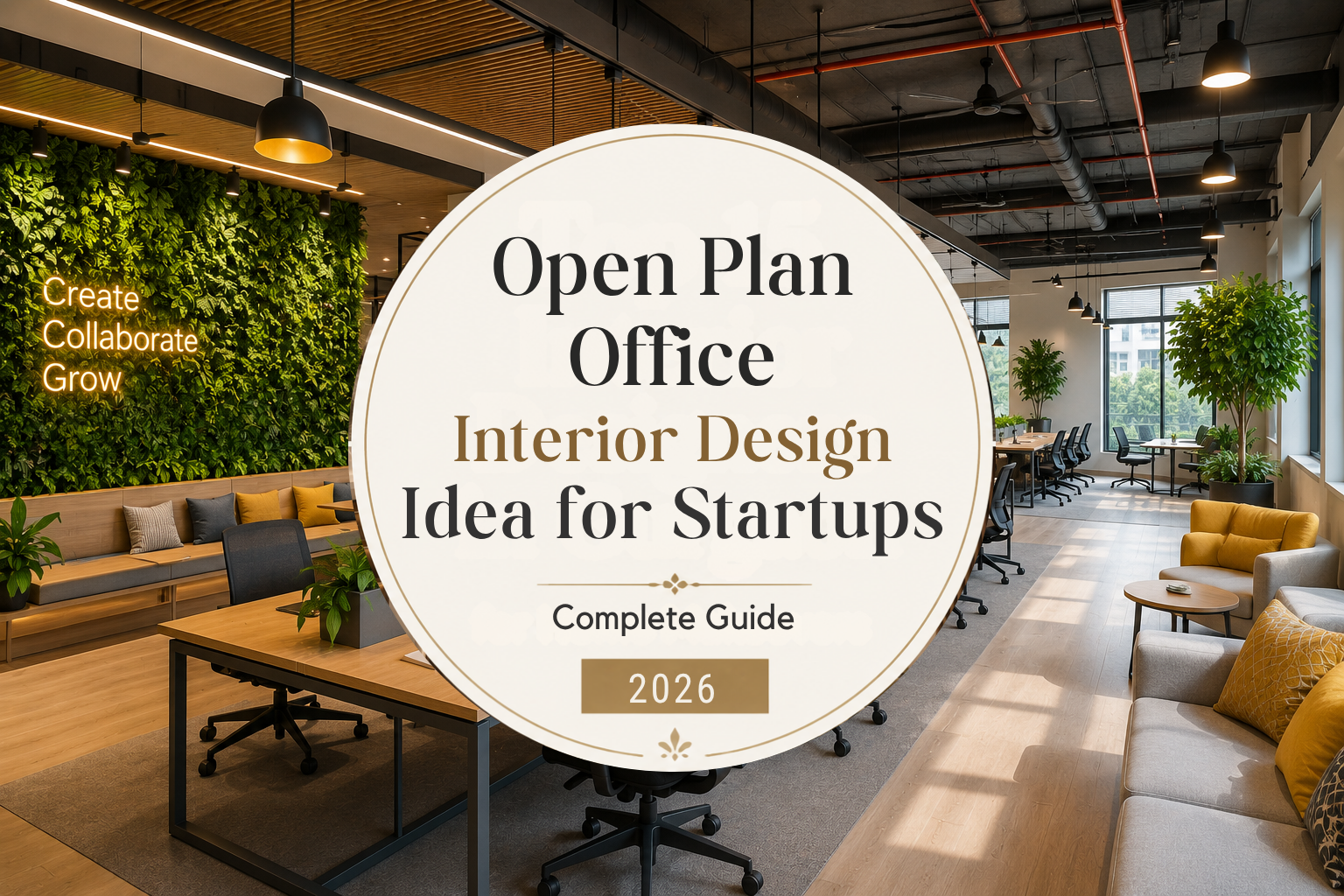
Open Plan Office Interior Design Ideas for Startups: Complete 2026 Guide
The best office interior design ideas for a startup are not the most expensive or the most Instagram-worthy. They are the ones that make your team want to come in, stay focused, collaborate naturally, and feel that the space reflects who you are as a company, before you have said a word to a client or investor walking through the door.
Open plan offices have evolved dramatically since the first wave of Silicon Valley-style designs swept through Indian startups and tech companies in the early 2010s. The fully open, bench-desk-only floor plate with a foosball table in the corner has given way to something more nuanced, a carefully zoned workspace that balances transparency and collaboration with acoustic privacy, focused individual work, and the social rituals that define a company’s culture.
This guide covers everything a startup founder, operations head, or growing tech team needs to know about designing an open-plan office in Gurgaon, Delhi, or the NCR in 2026, from zoning philosophy and layout strategy to material choices, lighting, acoustic solutions, and real fit-out costs.
Open Plan Office, India 2026 Quick Facts
- India’s commercial office interior design market is projected at ₹22,000 crore by 2027 (IBEF)
- Gurgaon’s Cyber City, DLF Phase 2 & Udyog Vihar account for 28% of NCR’s Grade-A office absorption
- Startups with well-designed offices report 33% higher employee retention than those with basic fit-outs (Leesman Index 2025)
- Activity-based working layouts reduce office space requirements by 25–40% versus traditional assigned-desk models.
- NBC India minimum office space: 4.5 sq. m. per person; best practice is 6–8 sq. m.
- Average office fit-out in Gurgaon 2026: ₹800 – ₹5,000 per sq. ft., depending on grade
In This Article
- Why Office Design Matters More Than Ever for Startups
- The 6-Zone Framework for Open Plan Startup Offices
- 4 Open Plan Layout Strategies, Which Fit Your Team?
- 12 Office Interior Design Ideas for Startups in 2026
- Acoustic Solutions: The Most Underinvested Area
- Office Lighting, Beyond the Fluorescent Tube
- Brand Integration, Making the Space Feel Like You
- Office Fit-Out Cost in Gurgaon / NCR 2026
- 5 Common Startup Office Design Mistakes
- Frequently Asked Questions
Why Office Interior Design Matters More Than Ever for Startups in 2026
The post-pandemic shift has permanently changed what employees expect from an office. After two years of working from home, people who return to an office need a reason to be there. A beige-walled room with rows of identical desks is not a reason. A thoughtfully designed space that enables better collaboration, deeper focus, and a stronger sense of belonging, that is.
For a startup, this matters in three very concrete ways.
Talent attraction and retention. In Gurgaon’s hyper-competitive tech and startup hiring market, competing against the offices of Google, Microsoft, and EY in Cyber City, your office is a recruiting tool. Candidates assess the quality of your office as a proxy for the quality of your company. A space that feels considered, well-lit, and energetic signals organisational health. A shabby fit-out signals indifference to the team’s experience.
Culture formation. Culture is not what you write on a values poster. It is the behaviour that your physical environment encourages. An office where the founder sits in a closed corner cabin, separated from the team by a partition wall, creates a hierarchy, whether intended or not. An open plan where the leadership sits among the team creates a very different dynamic. The spatial arrangement is the culture made physical.
Investor and client perception. Every pitch meeting, client visit, and investor walkthrough begins before a word is spoken; it begins when your guest walks in the door and reads the space. A well-designed office communicates that you are serious, that you invest in your team, and that you have a clear point of view on who you are.
Our commercial and multipurpose design team at Studio Rivet has designed startup and corporate workspaces across Gurgaon, Delhi, and NCR. The single most consistent finding across every project: the teams that invested thoughtfully in their space reported the strongest sense of company identity and team cohesion.
The 6-Zone Framework for Open Plan Startup Offices
The most common mistake in open plan office Interior design is treating the entire floor as a single zone, one activity, one height, one lighting level, one acoustic experience. The result is a space that does everything adequately and nothing well.
The best open plan offices are actually a collection of carefully designed micro-environments, each optimised for a specific type of work. Here are the six zones every startup office needs, regardless of floor area.
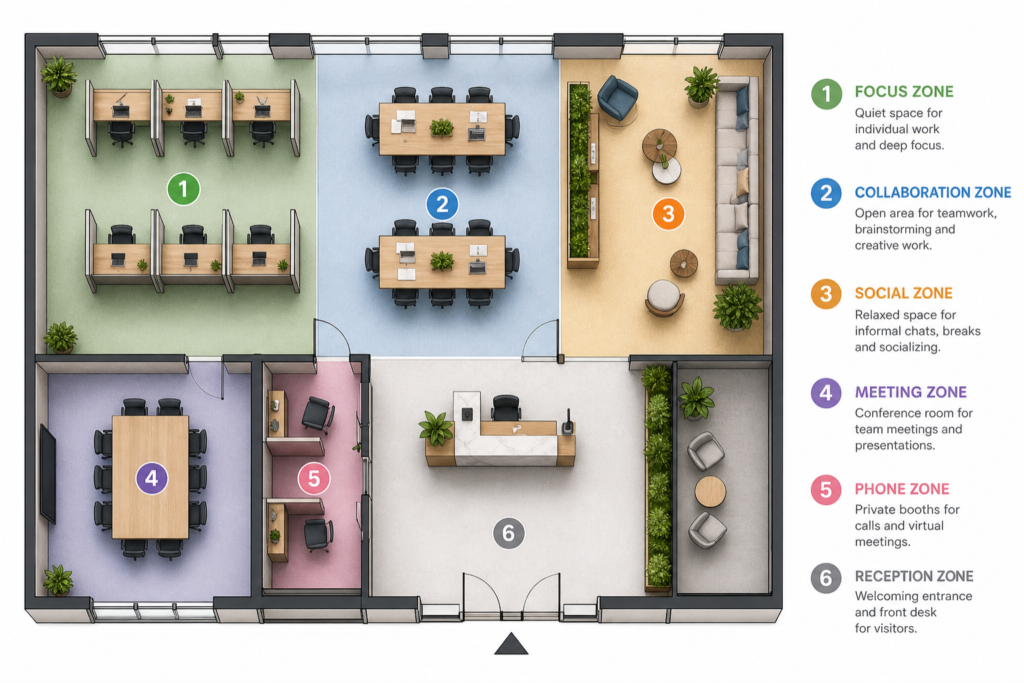
Zone 1, The Focus Zone
Individual, heads-down, deep work. This is where developers write code, analysts build models, and writers produce drafts. The focus zone requires the lowest acoustic disturbance in the office, positioned away from entrances, kitchens, and social areas. Bench desks work well here, but each position needs acoustic separation, either a low desk screen (400–500mm height) or a deliberate layout buffer from the collaboration zone.
Design signals: Slightly lower ceiling treatment or a dropped lighting plane signals “quiet here.” Cooler, brighter lighting (4000–5000K) supports sustained concentration. Minimal visual clutter.
Zone 2, The Collaboration Zone
Team discussions, stand-ups, design reviews, sprint planning, and whiteboarding. This zone should be at the energetic heart of the office, visible from the focus zone (to feel connected) but acoustically separated from it. High tables with stools, writable surfaces (whiteboard paint or wall-mounted whiteboards), and good overhead lighting make this zone highly functional.
Design signals: Higher energy, more visual interest. Brand colour accent walls. Writable surfaces. Mixed seating heights. Good video conferencing infrastructure for hybrid teams.
Zone 3, The Meeting Zone
Formal and semi-formal discussions: client meetings, investor pitches, HR conversations, performance reviews. These require an acoustic enclosure, glazed partition meeting rooms with proper acoustic seals on the doors. For a 20-person startup, 1–2 meeting rooms (4–6 person capacity each) are typically sufficient. Overbuilding meeting rooms is one of the most common space-planning mistakes in small offices.
Design signals: The meeting room is the most important branding surface in the office; this is where clients and investors sit. Invest in quality here: a good table, good chairs, considered lighting, and a brand-consistent wall treatment.
Zone 4, The Social Zone
Informal conversation, team lunches, coffee rituals, casual one-on-ones. The social zone is where company culture is actually formed and transmitted, more than any team meeting or town hall. It should be warm, comfortable, and feel noticeably different from the work areas. A well-designed pantry/café zone with a proper coffee counter, lounge seating, and a mix of table heights is the best investment most startups can make.
Design signals: Warmer lighting (2700–3000K). Softer, residential-style materials, upholstered benches, wood tones, and plants. Games or social objects (a magnetic pin board, a reading wall) that give people something to engage with during informal time.
Zone 5, The Phone / Focus Pod Zone
Individual calls, video interviews, and one-on-one conversations that need privacy without requiring a full meeting room. Phone pods, small acoustic booths for 1–2 people, have become one of the most-used and most-valued elements of any open plan office. In an Indian startup context where many employees are on calls throughout the day (sales, client management, recruitment), phone pods are not a luxury; they are infrastructure.
Design signals: Small, enclosed, acoustically treated booths or alcoves. Can be purchased as ready-made acoustic pods (Framery, Hushoffice) or custom-built with gypsum walls, acoustic infill, and a glass door.
Zone 6, The Entry / Reception Zone
The first space a visitor experiences. Even if you have no full-time receptionist, the entry zone should be clearly defined, well-branded, and visually impressive. This is the single most impactful design investment per square foot in any office. The entry zone creates the entire first impression for clients, candidates, and investors.
Design signals: Brand name or logo wall (dimensional lettering, backlit, or material inlay). Good ceiling feature, a lighting element or architectural detail that stops you when you walk in. A comfortable waiting seat. Fresh greenery.
4 Open Plan Layout Strategies for Startups
Once the zone framework is clear, the next decision is how to arrange those zones in your floor plate. These are the four most effective layouts for startup offices.
1. The Perimeter Focus + Central Collaboration Layout
Work desks run along the perimeter walls (natural light, heads facing outward), with the central floor area given to collaboration tables, informal seating, and social zones. Meeting rooms and phone pods are positioned near the entry to keep traffic away from focus areas. This is our most recommended layout for rectangular floor plates up to 5,000 sq. ft.
Best for: Teams of 15–60 people. Standard rectangular office spaces in Gurgaon’s DLF Cyber City, Udyog Vihar, and NH-48 corridor buildings.
2. The Neighbourhood Layout
The team is divided into functional “neighbourhoods”, product, engineering, sales, and ops, each with its own cluster of desks, a small collaboration table, and shared storage. Common amenities (pantry, meeting rooms, phone pods) are positioned centrally and shared across all neighbourhoods. This layout scales naturally as the company grows; adding a new neighbourhood is straightforward.
Best for: Series A and Series B startups of 40–150 people with distinct functional teams that work closely within their group but need occasional cross-functional collaboration.
3. The Activity-Based Working (ABW) Layout
No assigned desks. Employees choose where to sit each day based on what they are working on. The floor is divided entirely by activity type rather than by team. Focus areas, collaboration benches, social spaces, phone pods, and meeting rooms are all available to everyone. This layout maximises space efficiency; a team of 60 can comfortably work in a space designed for 40 because not everyone is in the office simultaneously.
Best for: Remote-first or hybrid startups with 50%+ attendance variation day to day. Companies with a strong laptop-based working culture. Not ideal for teams that need hardware-heavy fixed workstations (hardware engineers, video editors with fixed monitors).
4. The Studio Layout
Borrowed from architecture and design studios, this layout places large communal work tables at the centre, writable walls on all sides, and material/reference displays throughout. It encourages radical transparency; everything is visible, and everyone can see everyone’s work. It is deliberately anti-hierarchical and anti-siloed.
Best for: Design-led startups, creative agencies, product studios, and architecture firms. Teams where visual collaboration and shared critique are core to the work. Our own studio at 49 Arjun Marg, DLF Phase 1, follows a version of this model.
12 Office Interior Design Ideas for Startups in 2026
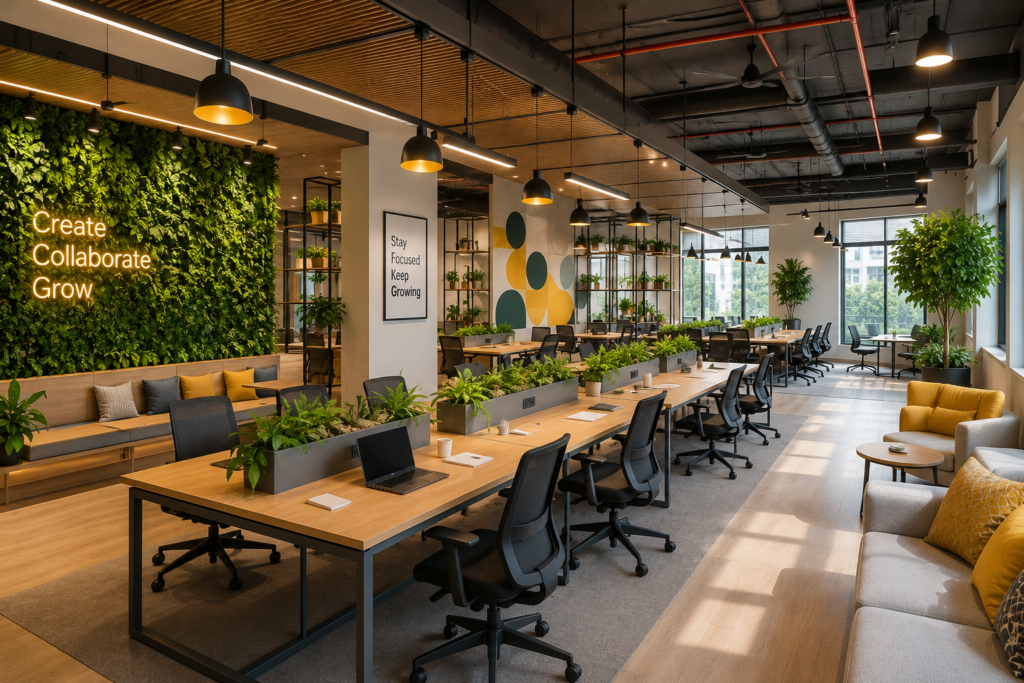
1. The Biophilic Feature Wall
A living wall, a vertical garden of preserved or living moss, ferns, and tropical plants, installed on the main reception-facing wall or behind the collaboration zone, is one of the highest-impact single design investments in any startup office. Biophilic elements reduce workplace stress, improve air quality perception, and signal that the company cares about the environment in which its people work.
Living walls in India require a maintenance programme (watering, lighting, plant replacement). Preserved moss walls require no maintenance and look equally striking. Cost: ₹800–₹2,500 per sq. ft. of wall area, including frame and installation.
2. Writable Surfaces Throughout the Collaboration Zone
Whiteboard paint applied to the full height of one or two walls in the collaboration zone transforms those surfaces into working canvases. Combine with a magnetic primer underneath to create a magnetic and writable surface. In a design or engineering startup where visual problem-solving is constant, writable walls become one of the most-used elements in the entire office. Cost: ₹80–₹150 per sq. ft. for whiteboard paint application.
3. Acoustic Baffles and Suspended Ceiling Panels
Acoustic ceiling baffles, rectangular panels of high-density acoustic foam or felt, suspended horizontally or at angles from the ceiling grid, are simultaneously a design element and the most effective tool for managing noise in an open plan office. In 2026, acoustic baffles are available in a wide range of colours and forms that add visual texture to an otherwise plain ceiling. This is the one acoustic investment that pays the highest return per rupee.
4. Brand Colour Zoning
Rather than painting every wall in the company’s brand colour (which creates visual fatigue and makes the office feel like a billboard), use brand colour strategically, one accent wall in the reception zone, a coloured strip along the ceiling edge in the collaboration zone, and branded upholstery on selected chairs. The 70/25/5 rule: 70% neutral, 25% secondary tone, 5% brand accent.
5. Height-Varied Furniture
A single height, everyone sitting at a standard desk, creates a monotonous spatial experience and reduces the variety of working postures your team can adopt throughout the day. Mix standard desks (720–740mm), standing desk converters or full sit-stand desks (adjustable 650–1,250mm), bar-height collaboration tables (900–1,000mm), and low lounge seating (400–450mm). The visual result is a dynamic, energetic floor plate. The ergonomic result is a team that moves more and sits less.
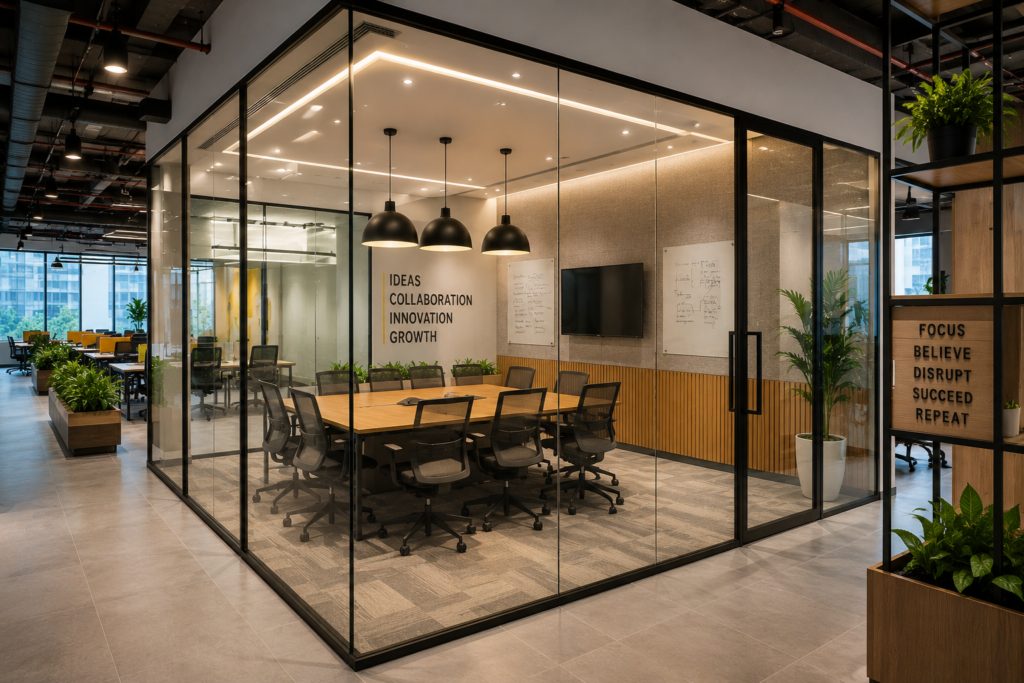
6. The Glass-Walled Meeting Room
Solid-wall meeting rooms in a small office feel like closets and visually shrink the space. Fully glazed meeting rooms with full-height glass partition walls and integrated smart film (switchable privacy glass) give you a visual connection to the broader space when open and complete privacy when needed. Smart film is now available in India at ₹1,200–₹3,500 per sq. ft., a worthwhile investment for client-facing meeting rooms.
7. Pendant Lighting Over Collaboration Tables
Pendant lights hung low over high collaboration tables create an intimate, defined space within the broader open plan, a “room within a room” effect without any walls. Use warm white pendants (2700–3000K) at 600–700mm above the table surface. This is one of the simplest and most effective spatial layering techniques in office interior design, and it costs a fraction of partition walls.
8. The Café-Style Pantry
The pantry is the social engine of the office. An investment in a properly designed pantry, a proper coffee counter, a mix of bar stools and lounge seating, good lighting, and a natural material palette (wood tones, stone-look countertop, plants) returns significant value in team morale, informal conversation, and the quality of life at work. The pantry should feel noticeably different from the work area, warmer, softer, more residential. Budget: ₹3-₹8 lakh for a well-equipped pantry in a 30-50 person office.
9. Cable and Technology Infrastructure First
One of the most common and most expensive mistakes in startup offices is designing the space beautifully and then retrofitting the IT infrastructure, power, data, video conferencing, and display screens as an afterthought. In 2026, plan for power points every 1.5–2 metres along all desk runs, a structured cabling system, ceiling-mounted video conferencing hardware in all meeting rooms, and display screens above collaboration tables. This infrastructure is invisible when done right and enormously disruptive when it needs to be added later.
10. Flexible, Reconfigurable Furniture
A startup’s headcount, team structure, and working habits change rapidly, often faster than the lease cycle. Invest in furniture that can be reconfigured without tools: modular desk systems, tables on castors, stackable chairs, and moveable storage units. This is significantly more valuable than fixed, custom-built furniture in the first 2–3 years of an office. Reserve custom-built elements for permanent features, the reception wall, the pantry counter, and the meeting room joinery.
11. The Library Wall
A floor-to-ceiling bookshelf wall, filled with a mix of reference books, design objects, industry magazines, and team-curated objects, serves as an acoustic buffer between zones, a visual anchor for the social area, and a genuine cultural artefact of the company. It communicates intellectual curiosity, and it photographs beautifully. Cost: ₹40,000–₹1,50,000 depending on size and material quality.
12. Outdoor / Terrace Working Space
Many Gurgaon office buildings, particularly in DLF, Sushant Lok, and South City, have accessible terraces or balconies attached to office units. In NCR’s climate (October–March is genuinely pleasant), an outdoor working area with weather-resistant seating, shade structures, and good Wi-Fi extension is one of the highest-return additions to any office. It is also one of the strongest signals a company can send to its team about the quality of life at work.
Acoustic Solutions: The Most Underinvested Area in Indian Office Interior Design
Noise is consistently ranked as the top productivity complaint in open plan offices globally. In India, where open plan adoption accelerated quickly without the accompanying acoustic investment, this problem is particularly acute. Here is a systematic approach to office acoustics.
| Acoustic Solution | Effectiveness | Cost Range | Best Placement |
|---|---|---|---|
| Acoustic ceiling baffles | Very High | ₹120–₹350/sq.ft. | Above focus + collaboration zones |
| Acoustic wall panels | High | ₹150–₹400/sq.ft. | Behind desks, end walls of the focus zone |
| Carpet / acoustic vinyl flooring | High (impact sound) | ₹60–₹200/sq.ft. | Focus zone, meeting rooms |
| Upholstered furniture | Medium | Part of the furniture budget | Social + lounge zones |
| Glazed meeting room with acoustic seal | Very High (isolated) | ₹1,800–₹4,000/sq.ft. | Meeting rooms, phone pods |
| Planter/bookshelf dividers | Low-Medium | ₹20,000–₹80,000 per unit | Zone boundaries |
| White noise / sound masking system | Medium-High | ₹150–₹300/sq.ft. | Entire floor plate (ceiling-mounted speakers) |
Our recommendation for a startup on a typical budget: Invest first in acoustic ceiling baffles (highest ROI), then a proper acoustic seal on meeting room doors, then carpet or acoustic vinyl in the focus zone. This combination addresses the three biggest noise sources, reverberation from hard surfaces, meeting room sound bleed, and footfall noise, at a reasonable cost.
Office Lighting in 2026, A Zone-by-Zone Guide
Lighting is the most transformative single element of office interior design; it affects alertness, mood, perceived space size, and visual quality more than any other element. The shift from a single colour temperature, single intensity ceiling grid to a zoned, layered lighting system is one of the most effective upgrades any startup office can make.
| Zone | Recommended Colour Temp | Illuminance (lux) | Fitting Type |
|---|---|---|---|
| Focus / Desk Zone | 4000–5000K (neutral-cool white) | 400–500 lux | Linear LED panels or suspended troffers above desks |
| Collaboration Zone | 3500–4000K | 350–450 lux | Pendants above high tables + recessed spots |
| Meeting Rooms | 3000–4000K (tunable) | 300–500 lux (dimmable) | Recessed downlights + table-level task light |
| Social / Pantry Zone | 2700–3000K (warm white) | 200–300 lux | Pendants + cove or wall wash + accent spots |
| Reception / Entry | 2700–3000K | 150–250 lux ambient + feature lighting | Feature ceiling element + wall wash on brand wall |
Human-centric lighting tip: Tunable white LED systems, which automatically shift colour temperature throughout the day from cooler (morning, afternoon) to warmer (evening), have become significantly more affordable in India in 2026. For a startup with extended working hours, this investment in circadian-supportive lighting pays for itself in reduced fatigue and better sleep quality for the team.
Brand Integration, Making the Office Feel Like You
Brand integration in office design is not signage. It is the translation of a company’s identity, its values, personality, and ambition, into physical space decisions. Done well, it is felt rather than read.
The Brand Story Wall
A single wall, ideally in the reception or collaboration zone, that tells the company’s story through a combination of large-format typography, photography, infographics, or material objects. Not a motivational poster, not a list of values, a genuine narrative that would mean something to someone who knows nothing about the company. This is the most powerful branding surface in the office, and most startups leave it blank.
Material as Brand Signal
Material choices communicate brand personality without words. Exposed concrete and raw steel signal engineering rigour and directness. Warm wood and natural textiles signal approachability and craft. Polished terrazzo and refined metal details signal ambition and precision. The material palette you choose for your office communicates your brand positioning as clearly as your visual identity, and is experienced much more viscerally.
Brand Colour, Where and How Much
As noted above, brand colour used at full saturation across large surfaces causes visual fatigue. The most effective applications are: dimensional letterform logo on the reception wall, a single feature wall in brand colour in the entry zone, brand-coloured upholstery on a subset of chairs, and brand colour integrated into custom graphics or wayfinding elements. Everything else should be neutral to allow the brand moments to breathe.
Office Fit-Out Cost in Gurgaon / NCR 2026
| Category | Basic Startup | Mid-Range | Premium |
|---|---|---|---|
| Civil & partitions (per sq. ft.) | ₹200–₹400 | ₹400–₹700 | ₹700–₹1,400 |
| Flooring (per sq. ft.) | ₹60–₹120 | ₹120–₹280 | ₹280–₹600 |
| False ceiling + lighting (per sq. ft.) | ₹150–₹280 | ₹280–₹500 | ₹500–₹1,000 |
| Furniture (per person) | ₹15,000–₹30,000 | ₹30,000–₹70,000 | ₹70,000–₹2,00,000 |
| Meeting rooms (per room, all-in) | ₹1.5–₹3L | ₹3–₹6L | ₹6–₹15L |
| Pantry/café zone (all-in) | ₹2–₹4L | ₹4–₹8L | ₹8–₹20L |
| Reception zone (all-in) | ₹1–₹2.5L | ₹2.5–₹6L | ₹6–₹20L |
| Total, 2,000 sq. ft. office (30 people) | ₹30–₹55L | ₹55–₹100L | ₹1–₹2.5Cr+ |
Budget tip: For an early-stage startup, prioritise in this order: (1) great lighting, highest visible impact per rupee, (2) acoustic ceiling treatment, highest quality-of-life impact, (3) one impressive reception wall, highest impression-per-rupee for client visits, (4) a proper pantry, highest team morale impact. Defer premium flooring and custom furniture until Series A.
5 Common Startup Office Design Mistakes
Mistake 1: Designing for Current Headcount Only
A startup that fits 25 people perfectly today may need to accommodate 50 in 18 months. Always design for 150–180% of your current headcount, either by choosing flexible furniture that can be reconfigured, or by leaving one zone deliberately underfurnished and available for expansion. Designing precisely to current needs guarantees a redesign within two years.
Mistake 2: Skipping the Acoustic Budget
Acoustic treatment is the first item cut in almost every startup office budget. Six months after opening, the team complains constantly about noise. This is the most predictable outcome in office design, and the most avoidable. Allocate a minimum of 8–10% of the total fit-out budget to acoustic treatment, ceiling baffles, meeting room seals, and soft furnishings in work areas.
Mistake 3: CEO / Founder Corner Cabin
A private cabin for the founder in a 20–40 person startup sends a clear hierarchical signal: the founder is separate from the team. In 2026, the most respected startup cultures in Gurgaon’s Cyber City and beyond have founders sitting in the open plan. If privacy is needed for sensitive calls or focused work, a phone pod or a shared meeting room serves the purpose without the cultural cost of a closed office.
Mistake 4: Underinvesting in the Entry Experience
The entry zone is the first and most remembered spatial experience for every visitor and new employee. A ₹50,000 investment in a good brand wall, proper lighting, and a comfortable seat in the reception zone creates a disproportionate impression. Most startups spend this money on an extra workstation instead. It is almost always the wrong choice.
Mistake 5: IT and AV Infrastructure as an Afterthought
Planning the fit-out without a detailed IT and AV infrastructure map leads to floor boxes that are in the wrong place, video conferencing systems retrofitted awkwardly into meeting rooms, and cable runs that surface-mount along walls because the ceiling was sealed before data conduits were installed. Work with your architect and IT team simultaneously before any civil work begins. See how we approach this integrated design process in our commercial and multipurpose design services.
Frequently Asked Questions, Office Interior Design Ideas
Design Your Startup Office with Studio Rivet
We design startup and commercial offices as complete, coordinated environments, including architecture, interiors, branding, acoustics, and technology infrastructure. Based in DLF Phase 1, Gurugram. Serving Delhi NCR since 2005.
📍 49 Arjun Marg, DLF Phase 1, Sector 26, Gurugram – 122002
📞 +91 9971685572 | 📞 +91 9818491069 | ✉️ info@studiorivet.in
Written by Studio Rivet
Studio Rivet is an architecture and interior design studio based at 49 Arjun Marg, DLF Phase 1, Gurugram. Founded in 2005, we work on residential, commercial, hospitality, and institutional projects across Delhi NCR. Learn more about us →
From Spaces to Systems: Rethinking Urban Development Through Design
Urban development is no longer limited to designing individual buildings or isolated spaces. As citi
Modular Kitchen Design: L-Shape vs U-Shape vs Parallel – Complete 2026 Guide
Choosing the right modular kitchen design is one of the most consequential decisions in any Indian h

Best Interior Designers in Gurgaon 2026: What to Look For
Choosing the right interior designers in Gurgaon is one of the most important decisions you will mak
Leave a Reply