


High-Rise vs Low-Rise Housing in India: Which One Is Right for You?
Every year, thousands of families across Gurgaon, Delhi, Mumbai, Bengaluru, and Pune face this exact question. The builder has shown you two projects. One is a gleaming 40-floor tower with views of the city, a rooftop pool, and a lobby that looks like a five-star hotel. The other is a compact cluster of G+3 or G+4 buildings around a proper garden, where you can hear children playing when you open the window, and the ground is actually reachable on foot in under a minute.
Both have a price tag. Both have a brochure. Neither brochure tells you what it is actually like to live there for five years.
We are architects who have designed both types of buildings. We have also watched our clients move into them and heard what they said three years later. This post is our attempt to give you the honest version of this comparison rather than the marketing version.
First, Let Us Define What We Are Actually Talking About
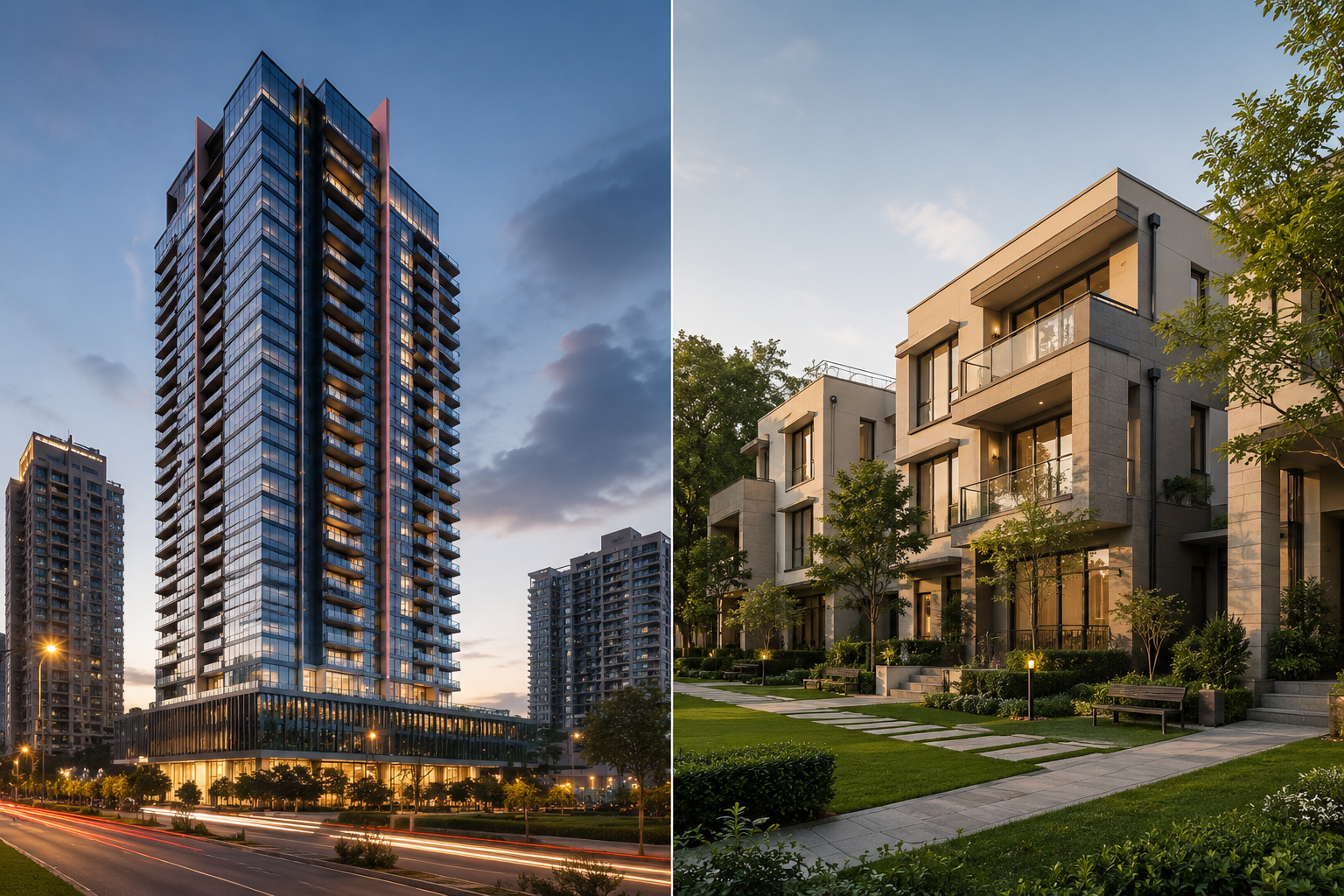
The terms high-rise and low-rise get used loosely in Indian real estate. Developers sometimes call anything above six floors a high-rise when it suits them, and sometimes they do not, when it does not. So let us use a clear definition.
Under the National Building Code of India 2016, any building above 15 metres in height is classified as a high-rise. In practical terms, this means five floors and above in most Indian construction types. Beyond that, the market tends to think of mid-rise as roughly five to twelve floors, and true high-rise as anything above twelve floors. The mega towers that have become a signature of Gurgaon’s Golf Course Extension Road, some going up to 40 and 50 floors, are a distinct category that we will discuss separately.
Low-rise in the Indian context means G+1 to G+4, which covers independent floors on plots, small apartment clusters, and the kind of residential building that has been the dominant housing type in older parts of Gurgaon, Delhi, and most Tier 2 cities for decades. Our own practice at Studio Rivet has designed extensively in the low-rise residential category, and we have strong feelings about what it does well and what it does not.
The Case for High-Rise Housing
Let us start with what high-rise does genuinely well, because the marketing version is not entirely wrong. It is just incomplete.
The view is real, and it matters.
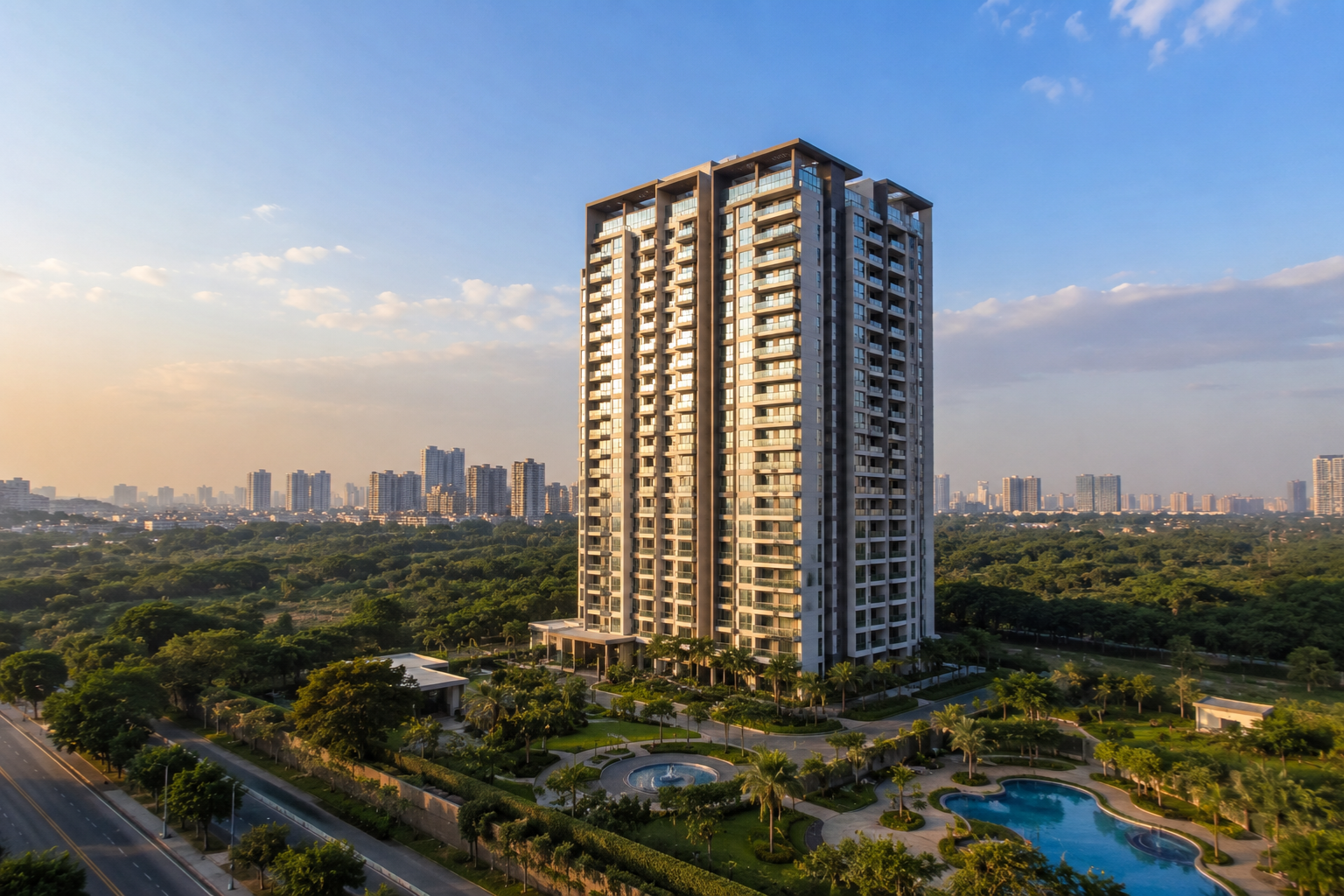
At the 20th floor and above in a Gurgaon tower, on a clear day after rain, you can see the Aravalli range to the south and the Delhi skyline to the north. The quality of light at that height, the sense of space, the absence of the visual noise of the street below, these are genuinely powerful things. They are not amenities. They are spatial experiences that affect how you feel at home every single day. People who live high up and then move to a low-floor apartment feel the difference immediately and often find it difficult to adjust.
Air quality is measurably better on higher floors.
This matters enormously in Delhi NCR, where ground-level pollution during winter months is genuinely dangerous. Multiple studies on PM2.5 concentration in Indian metros have shown that pollution levels drop significantly above the fifth floor and continue to drop with height. For families with children or members with respiratory conditions, this is not a trivial benefit. A family living on the 25th floor of a well-sealed building in Gurgaon is breathing cleaner air than a family on the ground floor of the same complex.
Security is structurally superior.
A high-rise tower with a single ground-floor access point, 24-hour security, CCTV coverage of every lift lobby and corridor, and a floor that is physically unreachable except through a controlled elevator is as secure a residential environment as you can get in an Indian city. For single professionals, women living alone, or families who travel frequently, this structural security is a meaningful advantage over a low-rise building where ground-floor access is inherently easier, and perimeter security is harder to maintain.
Land use efficiency and pricing per square foot
High-rise development allows a large number of homes to be built on a small parcel of land. In cities where land is extremely expensive, specifically Mumbai, central Delhi, and Gurgaon’s inner sectors, this land cost distribution across many floors makes each apartment’s base price lower than it would be if the same land were developed as low-rise. The common amenity infrastructure, the gym, the pool, the club house, the landscaped podium are also shared across a larger number of residents, making per-family cost lower than in a smaller low-rise development with the same amenities.
Modern infrastructure and amenities
Well-built high-rise towers in premium Indian developments tend to have better mechanical and electrical infrastructure than most low-rise buildings. 24-hour water supply from overhead tanks, 100% power backup for common areas and often for apartments, high-speed lifts, organised visitor parking, and centralised waste management are standard. Many low-rise developments, especially older ones, have none of these.
The Real Problems with High-Rise Living in India
Now for the part that does not make it into the brochure.
Elevator dependency is a genuine quality-of-life issue.
When you live on the 22nd floor, every trip outside your front door goes through an elevator. Taking out the garbage, getting the milk, picking up a courier, letting the child cycle in the building compound, going to the gym- everything requires waiting for a lift, sharing it with strangers, and waiting again. In a busy residential tower during morning rush hours, this wait can be five to ten minutes. Multiply that by several trips per day over years of living there, and you begin to understand why families with young children, elderly parents, or domestic staff who move in and out multiple times a day find high-rise living genuinely exhausting.
Elevator breakdowns, which happen in every building regardless of the developer’s reputation, strand residents on upper floors in ways that are not merely inconvenient but potentially dangerous for elderly residents or those with medical conditions.
Children cannot go downstairs alone until they are quite old.
This is something parents discover only after they have moved in. A six-year-old who wants to go play in the building compound cannot do so without an adult accompanying them to the lift, down 20 floors, out of the lobby, past the security desk, and to the play area. In a low-rise building, the same child can run downstairs to the garden while a parent watches from the window. This distinction shapes children’s independence, their physical activity levels, and their social development with other children in ways that are difficult to overstate.
Maintenance charges escalate significantly over time.
Every high-rise building has elevators that eventually need expensive refurbishment. Swimming pools that need constant chemical treatment and periodic lining replacement. Generator sets that run on diesel and need servicing. Facades that need periodic washing and re-sealing. Landscaped podiums that need maintenance. In the first years after possession, maintenance charges seem manageable. As the building ages and infrastructure starts requiring replacement, these charges tend to escalate sharply. In several Gurgaon high-rise societies that are now 12 to 15 years old, maintenance charges have doubled or tripled from their original levels, and disputes about maintenance are a constant source of resident society conflict.
The sense of community is often surprisingly low.
This sounds counterintuitive. A 500-unit tower should have more community than a 30-unit low-rise cluster. In practice, the opposite is often true. In a large tower, you may not know your neighbour’s name after five years of living side by side. The anonymity that feels like privacy when you move in can feel like isolation when something goes wrong, when there is a family emergency, when a child is ill at 2 AM, and you realise you do not have a single number to call in the building. Low-rise clusters, particularly in older Gurgaon sectors, tend to have significantly stronger informal social networks among residents.
Fire safety compliance varies enormously.
Under NBC 2016, high-rise buildings above 15 metres must have fire lifts, automatic sprinkler systems in common areas, pressurised staircases, refuge floors every 15 floors, and regular fire drills. In theory, this makes high-rises safer than low-rises in a fire emergency. In practice, the quality of fire safety implementation in Indian residential high-rises is inconsistent enough that it should be a specific due diligence item for any buyer. Ask directly for the fire NOC, ask when the last fire audit was conducted, and ask which floors have active sprinkler systems before signing anything.
The Case for Low-Rise Housing
Low-rise housing does not photograph as dramatically as a tower. It does not appear in the skyline. Developers tend not to market it as aspirational in the same way. But the families who live in thoughtfully designed low-rise developments tend to report higher long-term satisfaction than those in high-rise towers, and the reasons are worth understanding clearly.
Ground relationship changes everything for daily life.
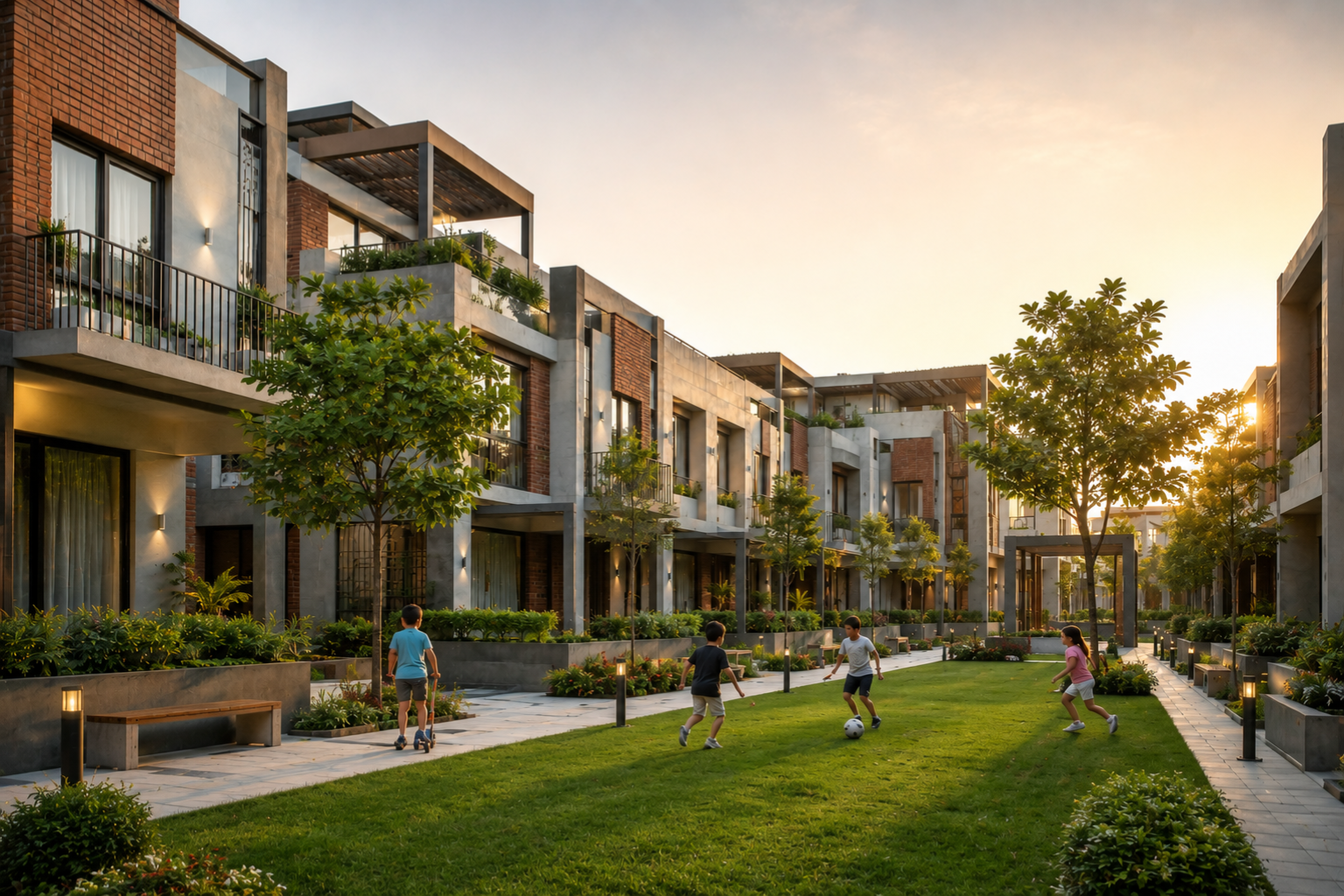
The ability to step outside directly onto the ground changes the quality of daily life in ways that are difficult to fully appreciate until you have lived both ways. Morning walks that begin at your front door. Children who develop genuine relationships with outdoor space because they can access it independently. Elderly parents who can sit in the garden without requiring help from a younger family member. Dogs that can actually be dogs. A direct relationship with the time of day, the season, the weather, and the neighbourhood, all of which are mediated and diluted the higher you live above the ground.
This is not nostalgia. It is a measurable quality of life difference that comes up consistently in post-occupancy research on residential satisfaction.
Lower operational complexity means lower lifetime costs.
A G+3 or G+4 building has one or at most two elevators, no swimming pool, minimal mechanical infrastructure, and a relatively simple façade. The maintenance cost per unit per month is a fraction of that of a high-rise tower. When the lift needs servicing, it costs a fraction of what a high-speed lift in a tower costs. When the exterior needs repainting, it requires a scaffolding that a local contractor can set up rather than specialised high-rise rope access teams. The lower operational complexity also means fewer sources of dispute in resident associations and simpler decision-making about building maintenance.
Better Vastu compliance is naturally achievable.
For families for whom Vastu Shastra is a genuine priority, low-rise housing offers significantly more control. In a plotted development or a small residential cluster, the architect has full freedom to orient every unit optimally, place the kitchen in the South-East, the master bedroom in the South-West, and the entrance facing North or East. In a high-rise tower, the apartment you are buying has its orientation determined entirely by which side of the building it sits on, and the developer’s floor plate is fixed for all units. If you end up with a South-West facing entrance because of where your unit sits in the building, there is nothing structural you can do about it. For a detailed look at how Vastu and modern architecture work together, read our post on whether Vastu and modern architecture can really coexist.
Design personalisation is genuinely possible.
In a low-rise independent floor or a plotted home, the design is yours. You choose the plan layout, the ceiling height, the material palette, the kitchen configuration, the degree of openness between spaces, and a hundred other things that define the character of your home. In a high-rise apartment, the developer has made all of these decisions in advance for hundreds of identical units. The only personalisation available is in the fit-out: which tiles, which wardrobe finish, which kitchen shutters. The architecture itself is not yours.
This matters more than most buyers realise until they have lived for a while in a space designed entirely by someone else for the average buyer rather than for their specific family.
Resale and rental markets are stable and broad.
Well-maintained low-rise housing in good locations tends to hold its value reliably. The buyer pool for a 3BHK floor in a good Gurgaon sector is broad: families who want space, investors looking for stable rental yield, buyers who specifically prefer low-rise for the reasons described above. There is no premium floor effect that concentrates all the resale value in one part of the building, as happens in high-rise towers where ground-floor and mid-floor units can be significantly harder to sell than the upper floors.
The Real Problems with Low-Rise Housing
Honesty requires covering both sides. Low-rise housing has genuine disadvantages that should factor into your decision.
Security is harder to achieve at the same level.
A low-rise building with multiple ground-floor entrances, a perimeter that is inherently more accessible, and a smaller resident population that cannot fund the same level of guard deployment as a large tower society will always be less structurally secure. This is a real difference. It matters most in areas where the immediate neighbourhood has security concerns, and matters less in established, calm residential areas like older DLF sectors or Sushant Lok.
The location premium is real and unavoidable.
Low-rise development is land-intensive. In cities and areas where land is extremely expensive, the cost of a low-rise home per square foot often ends up higher than a comparable high-rise apartment once you factor in the land cost. In central Mumbai, in inner Delhi colonies, and in Gurgaon’s most sought-after sectors, a genuinely well-located low-rise floor can cost more than a high-rise apartment of the same built-up area. You are paying for the land relationship as much as the built space.
Air quality is lower, and external noise is more present.
The clean air advantage of height is real, and it works in reverse. Ground-floor and lower-floor units in high-pollution urban areas bear the full brunt of vehicular emissions, dust, and the general atmospheric burden of Indian city ground levels. This is a particularly significant concern in Delhi NCR during winter. Families with respiratory sensitivities should factor this in carefully, especially if the low-rise development sits on or near a busy road.
Modern amenities come at a higher per-unit cost or not at all.
A 30-unit low-rise development cannot afford the swimming pool, the fully equipped gym, the concierge service, or the landscaped clubhouse that a 500-unit high-rise tower society can fund from its collective maintenance corpus. If you value these amenities, low-rise housing requires either a very large development that can afford the infrastructure or accepting that these facilities will not be available within the complex.
The Comparison Table: Both Sides Deserve
| Factor | High-Rise | Low-Rise | What It Means in Practice |
|---|---|---|---|
| Views and light | Better | Depends on surroundings | High-floor views are genuinely impressive; low-rise light depends on what is built around it. |
| Air quality | Better (upper floors) | Lower floors more polluted | Significantly in Delhi NCR, PM2.5 is measurably lower above the 5th floor |
| Security | Structurally superior | Harder to achieve | Single entry point + height advantage in high-rise; low-rise needs active investment in security |
| Ground access | Elevator dependent | Direct | Critical for children, the elderly, pets, and daily movement quality |
| Suitability for families | Moderate | High | Low-rise wins clearly for joint families, families with children, and elderly members. |
| Maintenance charges | Higher, escalate over time | Lower, more predictable | High-rise: Rs 3 to 12 per sq ft per month in Gurgaon; Low-rise: Rs 1 to 4 per sq ft per month |
| Design personalisation | Fit-out level only | Full architectural control | Low-rise plotted homes offer complete design freedom; high-rise apartments are standardised. |
| Vastu compliance | Limited (fixed floor plate) | Fully achievable | In high-rise, your orientation is fixed by which unit you buy; low-rise can be designed from scratch. |
| Community feeling | Often lower than expected | Stronger natural community | Smaller buildings create real neighbourhoods; large towers create anonymity despite shared amenities. |
| Amenities | Pool, gym, clubhouse standard | Limited to small developments | High-rise towers can afford premium amenities across a large resident base |
| Fire safety emergency egress | More complex, varies by builder | Simpler and faster | Low-rise evacuation is straightforward; high-rise requires functional fire lifts, sprinklers, and refuge floors. |
The Gurgaon-Specific Reality
Gurgaon is one of the most interesting places in India to consider this question because it has both housing types in such proximity, and the contrast between them is very visible.
The tower developments along Golf Course Extension Road, Southern Peripheral Road, and Dwarka Expressway represent the full spectrum of high-rise living in India, from genuinely well-built premium projects with excellent infrastructure to poorly maintained towers where the lifts are unreliable, the swimming pool is perpetually under repair, and the maintenance charges have tripled since possession. The brochures for all of them looked similar when they were launched.
The older sectors of Gurgaon, particularly DLF Phases 1 through 4, Sushant Lok, and South City, have an entirely different character. These are predominantly low-rise areas with wide, tree-lined roads, ground-level community life, and a sense of neighbourhood that many residents describe as their primary reason for never wanting to leave. The plot sizes are generous by urban standards, the distances to amenities are within walking distance, and the buildings themselves, while less glamorous than towers, have a genuinely human scale.
DLF Phase 1, specifically, where our studio is based, is a case study in what a well-planned low-rise residential development looks like at a neighbourhood scale. The combination of green coverage, plot sizes, road widths, and the slow pace of the street makes it one of the most liveable residential areas in the entire NCR, despite being surrounded by the full intensity of the city. We have written about what makes residential architecture work in this context in our detailed guide to low-rise residential architecture and in our post on what to look for in a residential architect in DLF Phase 1, Gurgaon.
So, Which One Should You Choose?
The honest answer is that it depends on who you are, what stage of life you are at, and what you actually value day-to-day rather than what you think you value based on a show flat visit.
Choose a high-rise if you are a working couple or a professional without children, if you travel frequently and value the security of a managed high-rise tower, if you live in an area where ground-level pollution is a serious concern, if the views matter deeply to you. You will genuinely appreciate them every day, and if you are buying in a land-scarce part of the city where high-rise is the only way to access a well-located address at a reasonable price.
Choose a low-rise if you have children or are planning to, if you have elderly parents living with you or visiting regularly, if you want to design your home rather than buy a standardised unit, if Vastu compliance is a genuine priority, if you have a dog or value any kind of natural outdoor relationship, if you want to know your neighbours, and if you are thinking about a 15 to 20 year horizon where escalating maintenance charges on ageing high-rise infrastructure become a real financial and quality of life concern.
The one thing we consistently tell clients who are genuinely torn: go and spend a full day in both types of projects. Not just the show flat, which is designed to make you want to buy. Go on a Tuesday morning. Go at 7 AM when the lifts are full and residents are leaving for work. Go at 6 PM when children are coming back from school. Talk to residents who have lived there for three or four years. The real picture emerges very quickly when you stop looking at the brochure and start looking at life.
If you are planning to build your own home in Gurgaon and want to understand what is architecturally possible on a residential plot, our interior design and architecture team at Studio Rivet would be glad to walk you through the options.
Frequently Asked Questions
Planning a Low-Rise Residential Project in Gurgaon?
Studio Rivet specialises in low-rise residential architecture and interior design across Delhi NCR. Based in DLF Phase 1, Gurugram since 2005. We design homes that are architecturally considered, Vastu-aware, and built to last.
49 Arjun Marg, DLF Phase 1, Sector 26, Gurugram 122002
+91 9971685572 | +91 9818491069 | info@studiorivet.in

Best Wall Colours for Homes (Room by Room Guide)
Paint is the cheapest and fastest way to change how your home feels, yet it is the one decision peop

Wallpaper vs Paint vs Texture: What Should You Choose?
When it is time to finish your walls, you face a simple but important choice: paint, wallpaper, or t

False ceiling design ideas for indian living rooms 2026
The false ceiling design for living room is no longer a luxury reserved for premium homes. In 2026,
Leave a Reply