



Architecture vs Interior Design: The Real Difference (And Which One You Actually Need)
Somewhere in the first conversation of almost every new residential project we take on at Studio Rivet, a client asks us: “So are you architects or interior designers?” And when we say we are both, the follow-up question is always the same. “What is the difference anyway?”
It is a completely fair question. In India especially, the two professions overlap in ways that are genuinely confusing to anyone who is not in the industry. Firms that call themselves interior designers do full renovations involving walls and structure. Architects design kitchens and specify tile patterns. Some studios offer everything under one roof. Some offer only one part. The terminology does not help because it is used inconsistently across the industry.
This post is our attempt to give you a genuinely clear answer, from the perspective of a studio that has been doing both for twenty years and understands where each discipline starts, where it ends, and where they overlap.
The Simplest Possible Way to Understand the Difference
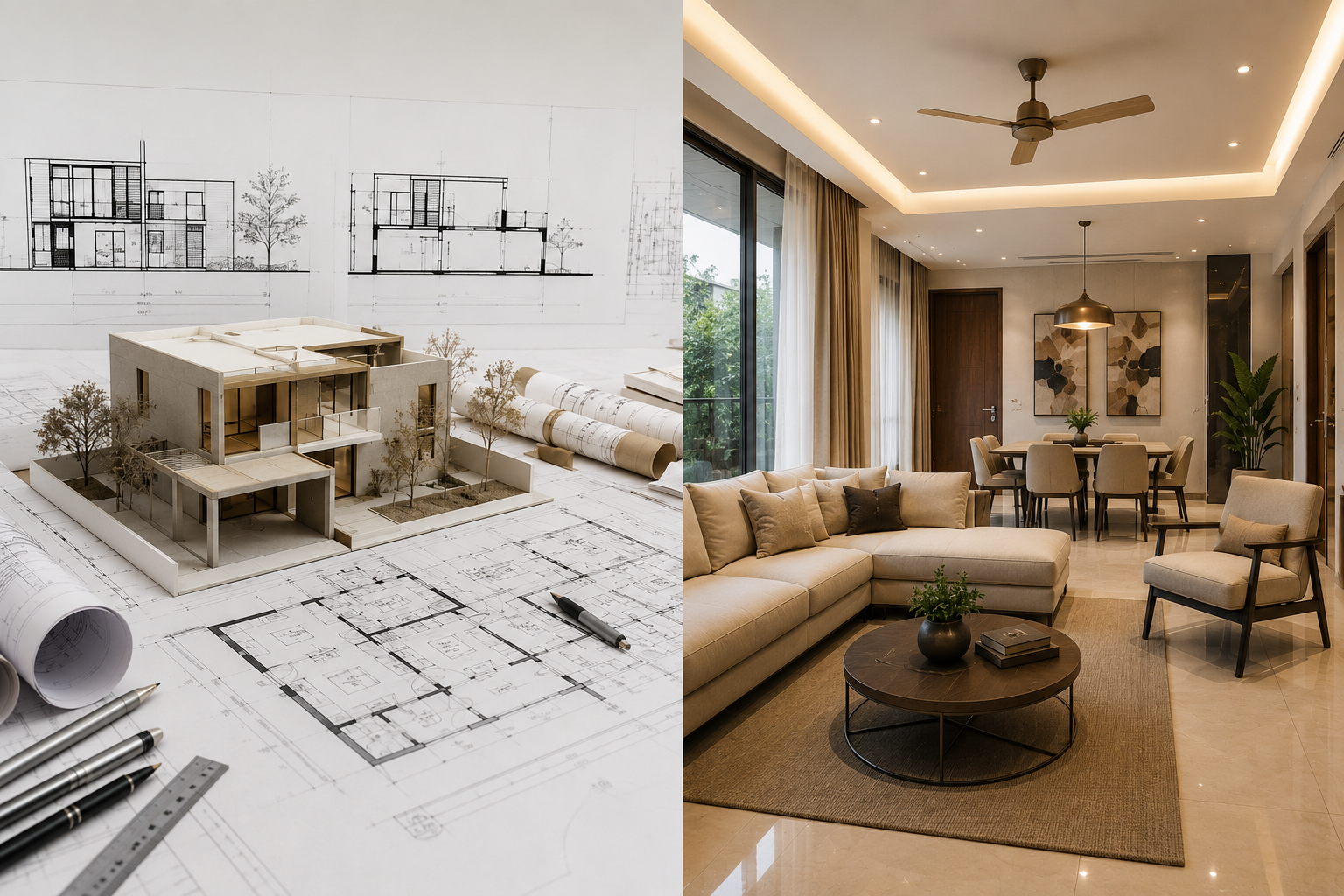
If you need a single sentence: an architect designs the building and an interior designer designs what goes inside it.
The architect is responsible for the shell, the structure, the form, the relationship of the building to its site and the sky above it. The interior designer is responsible for the experience of being inside that shell once it is built.
But that sentence, while accurate, leaves out the part that actually confuses people. Because the shell and the inside are not as separable as that sentence implies. The quality of light in a room depends on where the architect placed the windows. The ceiling height that makes a bedroom feel generous or cramped was determined when the architect set the floor-to-floor dimension. The material of the floor underfoot connects the outside to the inside in ways that both professions care about deeply. Architecture and interior design are not two separate boxes. They are two perspectives on the same continuous problem, and the best homes in India are designed by people who understand both.
What Architects Actually Do
An architect’s job begins before a single room is designed. It begins with the site: its orientation to the sun, the direction of prevailing winds, what surrounds it, how people will approach and enter it, and what the land itself is saying about what should be built there. This site analysis shapes everything that follows, from the placement of the main entrance to the position of every window.
The architect then works out the spatial programme: how many rooms, in what relationship to each other, what size, and at what position relative to the cardinal directions. This is called spatial planning, and it is the heart of architecture. How you move through a home, how rooms relate to each other, where natural light falls at different times of day, whether the kitchen is connected to the garden or buried at the back of the plan, whether the master bedroom is quiet at 7 AM or directly above the street, all of these decisions are made in the planning stage by the architect.
Once the spatial plan is established, the architect designs the building’s structure: the columns and beams, the walls, the roof, the staircases, and the structural logic that holds everything up. In India, this structural work is done in coordination with a licensed structural engineer, who designs the specific sizing and reinforcement of all load-bearing elements. The architect coordinates this structural work with the overall design to ensure that columns end up in sensible places and beams do not appear in the middle of living rooms.
The architect also handles statutory compliance. In India, any new construction and most significant structural renovation requires a building plan approved by the local municipal or planning authority. In Gurgaon, this is the DTCP (Directorate of Town and Country Planning) or the Municipal Corporation of Gurgaon. Plans are submitted through the HOBPAS (Haryana Online Building Plan Approval System) and can only be signed and submitted by a registered architect who holds a valid Council of Architecture registration and is empanelled with the relevant authority. An interior designer, regardless of skill or experience, cannot legally submit building plans for statutory approval. This is one of the clearest practical distinctions between the two roles in India.
Finally, the architect produces the complete set of construction drawings: floor plans, sections, elevations, structural drawings, electrical and plumbing layouts, and detailed joinery drawings that the contractor builds from. The architect also visits the site during construction to check that the building is being executed as designed, and to manage the inevitable on-site decisions that arise when drawings meet reality.
You can read a much more detailed version of how this process works in our guide to top residential architects in DLF Phase 1 Gurgaon, which covers every stage of a residential project from first brief to handover.
What Interior Designers Actually Do
An interior designer’s job begins where the architectural shell ends, or more precisely, it should begin at the same time but with a different focus. The interior designer is responsible for everything that happens within the walls that the architect has established.
This starts with spatial planning at the interior level: how the furniture is arranged within each room, how traffic moves through the space, where storage is positioned, and how each room connects visually and physically to the next. Good interior spatial planning is not about matching sofas to curtains. It is about understanding how people live in a space and designing the layout to support that.
The interior designer then specifies every material, finish, and fitting that defines the character of the space. Flooring materials and patterns. Wall treatments, whether paint, wallpaper, stone cladding, or timber panelling. Ceiling treatments and false ceiling layouts. Kitchen and wardrobe designs, including the structural specification of the cabinet carcass, the shutter material and finish, the hardware, and the countertop. Bathroom fittings and tile layouts. Lighting design, including the positions and types of fixtures, the colour temperatures, and the circuitry for different lighting zones.
Interior designers also select and specify furniture, either from standard ranges or through custom design, and coordinate the procurement and placement of soft furnishings, accessories, plants, and the hundred small objects that bring a home to life. This curatorial aspect of interior design, knowing what to include and what to leave out, is one of the most undervalued skills in the profession and one of the hardest to teach.
In a typical apartment renovation where no structural walls are being moved and no statutory approvals are required, an interior designer can handle the complete project independently. In a project that involves structural changes, the interior designer works alongside or under the coordination of an architect who manages the statutory and structural scope.

Education and Licensing in India: A Practical Guide
This is where things in India get genuinely important for anyone hiring a design professional.
To practice as an architect in India, a person must complete a Bachelor of Architecture degree, which is a five-year programme accredited by the Council of Architecture. After completing the degree, they must register with the COA, and in most states they must also qualify for empanelment with the local planning authority before they can submit building plans for approval. The COA number can be verified on the Council’s public database, and no registered architect should hesitate to share it with a prospective client.
Interior design in India does not have an equivalent mandatory licensing system. Anyone can call themselves an interior designer and offer interior design services, regardless of whether they have any formal training. This does not mean interior designers are less skilled or less valuable than architects. Many of India’s finest interior designers hold formal degrees from institutions like NID (National Institute of Design), NIFT, CEPT, or JJ School of Art, and they bring genuine expertise to their work. But it does mean that when hiring an interior designer in India, the absence of a mandatory licence puts a greater burden on the client to verify the professional’s qualifications, portfolio, and track record.
In practice, when you hire a studio like ours at Studio Rivet that offers both architecture and interior design, you are working with a team that has architects with full COA registration for statutory work and qualified design professionals handling interior specification. The division of labour is internal to the studio and managed seamlessly for the client.
Where the Two Professions Genuinely Overlap
The interesting territory is in the middle, and it is larger than most people realise.
Ceiling height is an architectural decision, but the false ceiling design that a client ultimately lives with is an interior one. The position of a window is decided by the architect, but the way that window is dressed, the depth of the reveal, the material of the sill, and the choice of whether to use sheer curtains or solid shutters are interior decisions that profoundly affect the spatial quality of the room. The structural column in the living room is fixed by the engineer and coordinated by the architect, but how it is treated, whether it is concealed, expressed, clad in stone or timber, painted to match the wall or used as a design feature, is an interior design decision that changes the entire character of the room.
This is why the best homes in India are designed by studios that treat architecture and interior design as continuous disciplines rather than two separate services that are handed off from one to the other. When the architect who designed the room also thinks about how it will be lived in, the spatial quality of the finished home is consistently higher. When the interior designer understands the structural and environmental logic of the building they are working within, their material and spatial decisions are better informed.
This integrated approach is central to how we work at Studio Rivet. We do not hand over a completed shell to an interior designer after the building is finished. We think about how the space will be experienced, furnished, lit, and lived in from the very first sketch of the plan.
A Comparison That Might Actually Help You
| Scope of Work | Architect | Interior Designer | Both Together |
|---|---|---|---|
| New building construction | Required | Not applicable | Ideal |
| Building plan approval (DTCP/BMC) | Required | Cannot submit | Architect handles |
| Structural changes (removing walls) | Required | Cannot approve | Ideal |
| Apartment interior renovation (no structural changes) | Helpful but not mandatory | Can handle fully | Best outcome |
| Kitchen and wardrobe design | Can do | Specialisation | Seamless |
| Material and finish specification | Can do | Core expertise | Best depth |
| Lighting design | Can do | Core expertise | Best outcome |
| Furniture selection and placement | Rarely | Core expertise | Fully coordinated |
| Vastu-compliant spatial planning | Best positioned | Limited to interior adjustments | Fully integrated |
| Site supervision during construction | Standard scope | Depends on studio | Continuous coverage |
Which One Do You Actually Need for Your Project?
Let us be very direct about this because it is the question that actually matters to most people reading this post.
If you are planning to build a new home on a plot in Gurgaon, Delhi, or anywhere in India, you need a registered architect. There is no alternative. You cannot get building plan approval without one, and attempting to build without an approved plan exposes you to demolition orders and legal liability. The architect should be registered with the COA and empanelled with the relevant local planning authority.
If you are planning to add a floor to an existing building, relocate the kitchen by moving plumbing walls, remove a wall between the living room and dining area, change the position of a window, or make any other change that touches the structural or regulatory envelope of the building, you need an architect, even if the rest of the project is purely interior in nature.
If you are planning a full interior renovation of an existing apartment, where no walls are being moved and no statutory approvals are required, a qualified interior designer can handle the complete project. An architect is not strictly necessary, though the project will generally benefit from someone who thinks spatially at both levels.
If you are doing a single-room renovation, a kitchen upgrade, a new set of wardrobes, or a false ceiling and lighting update, an interior designer handles this entirely.
And if you want a home that is designed as a complete, coherent environment, where the architecture and the interiors are developed together as a single design act rather than two separate projects, the best answer is a studio that offers both. This is how we work at Studio Rivet, and in our experience, it consistently produces the best homes. The spatial quality that comes from an architect thinking about ceilings, light, and proportion combined with the material and detail quality that comes from deep interior design expertise produces results that neither discipline achieves alone.
A Note on Interior Architecture
There is a third term you will occasionally come across in India, particularly in the context of boutique studios and internationally trained designers: interior architecture. This refers to the practice of transforming existing buildings through significant spatial interventions that go beyond standard interior design but do not involve building new structures. Removing walls to create open-plan spaces, redesigning staircase positions, inserting mezzanine levels within double-height volumes, adding internal courtyards, these are all examples of interior architecture.
Interior architects work at the boundary between architecture and interior design, which is exactly where the most interesting residential transformations happen. In India, interior architectural work that involves structural modifications still requires the involvement of a registered architect for statutory compliance, but the design thinking is genuinely at the intersection of both disciplines.
Falmouth University in the UK, one of the sources we reviewed in writing this post, describes interior architecture as “a discipline that focuses on the spatial design and structural aspects of interior spaces.” That definition captures it well. It is architecture applied to the inside of buildings, and it is the kind of work our studio finds most creatively interesting.
The Indian Context Makes This Different
One thing that the international sources on this topic tend to miss is how different the Indian residential project context is from Western markets. In India, most homeowners who are renovating or building for the first time are navigating a market where contractors are often independent tradespeople rather than large coordinated companies, where material markets are fragmented across multiple vendor types, where site supervision is genuinely necessary rather than optional, and where the quality gap between a well-supervised project and a poorly supervised one is enormous.
In this context, the choice between hiring an architect and hiring an interior designer is not just a question of scope. It is also a question of who is responsible for the project as a whole and who will be present on site when things go wrong, which they inevitably do in any Indian construction project regardless of how good the contractor is.
A studio that combines both disciplines and provides genuine site supervision across both the structural and interior phases of a project gives a homeowner significantly more protection and significantly better outcomes than splitting the two roles across two different professionals who may or may not coordinate well with each other.
If you are thinking about a project in Gurgaon or Delhi NCR and want to understand specifically what our studio can offer for your brief, our interior design services and residential architecture pages explain our process in detail. And if you want to understand what the full hiring process looks like from a homeowner’s perspective, our guide on how to choose the best interior designer in Gurgaon covers every question worth asking before you sign anything.
Frequently Asked Questions
Need Both Architecture and Interior Design for Your Project?
Studio Rivet is an integrated architecture and interior design studio based in DLF Phase 1, Gurugram. We have been doing both together since 2005, for residential, commercial, hospitality, and institutional projects across Delhi NCR.
49 Arjun Marg, DLF Phase 1, Sector 26, Gurugram 122002
+91 9971685572 | +91 9818491069 | info@studiorivet.in
Written by Studio Rivet
Studio Rivet is an architecture and interior design studio at 49 Arjun Marg, DLF Phase 1, Gurugram. Founded in 2005. Residential, commercial, hospitality and institutional projects across Delhi NCR. About us

9 Budget-Friendly Interior Design Hacks for Your 3 BHK Home
Designing a 3 BHK home is an exciting opportunity to create a space that reflects your personality,

False ceiling design ideas for indian living rooms 2026
The false ceiling design for living room is no longer a luxury reserved for premium homes. In 2026,

Luxury Interior Design in Gurgaon | Villas & Penthouses
A villa in South City or a penthouse overlooking Golf Course Road is not just a bigger home. It come
Leave a Reply