


Modular Kitchen Design: L-Shape vs U-Shape vs Parallel – Complete 2026 Guide
Choosing the right modular kitchen design is one of the most consequential decisions in any Indian home interior project. Get the layout wrong and no amount of beautiful shutters or premium appliances will save you from a kitchen that is frustrating to cook in every single day. Get it right and even a modest 80 sq. ft. kitchen can feel spacious, efficient, and genuinely enjoyable.
This guide compares the three most popular modular kitchen layouts for Indian homes — L-shape, U-shape, and parallel (galley) — with real dimensions, cost breakdowns, work triangle analysis, and honest recommendations based on our studio’s experience designing kitchens across Gurgaon, Delhi, and NCR. Whether you are fitting out a 2BHK apartment in DLF Phase 1 or redesigning the kitchen of a villa in Sushant Lok, this guide gives you the information to make the right choice.
Quick Facts — Modular Kitchens in India 2026
- India’s modular kitchen market is projected to reach ₹14,800 crore by 2027, growing at 40%+ annually (IBEF)
- L-shape is the most installed layout in Indian apartments, suits 60–65% of residential kitchens
- The ideal kitchen work triangle should total 12–26 feet across all three sides
- Average modular kitchen cost in India in 2026: ₹1.5 lakh – ₹12 lakh+, depending on size and grade
- Minimum ceiling height for wall cabinets to full height: 2.7 metres
- Standard counter height in India: 32–34 inches (820–860 mm) from finished floor
In This Article
- What Is a Modular Kitchen — Basics First
- The Kitchen Work Triangle — Why It Matters
- L-Shape Modular Kitchen — Deep Dive
- U-Shape Modular Kitchen — Deep Dive
- Parallel (Galley) Kitchen — Deep Dive
- Side-by-Side Comparison Table
- Materials — Shutters, Countertops & Hardware
- Modular Kitchen Cost in India 2026
- Which Layout Is Best for Indian Cooking?
- 6 Common Modular Kitchen Mistakes
- Frequently Asked Questions
What Is a Modular Kitchen — And Why It Replaced Traditional Carpentry
A modular kitchen is a factory-manufactured kitchen system assembled from standardised, interchangeable units — base cabinets, wall cabinets, tall units, and accessories — that are installed on site. Unlike a traditional Indian carpenter-built kitchen, modular kitchens are produced under controlled factory conditions with precision machinery, consistent finishing quality, and engineered board materials (plywood, HDMR, MDF) rather than raw wood.
The shift from traditional carpentry to modular systems in Indian homes accelerated significantly after 2015, driven by three factors: faster installation (days versus weeks), more consistent quality, and the growing influence of European kitchen aesthetics in Indian urban markets. Today, virtually every interior design project in Gurgaon includes a modular kitchen as a standard component.
That said, modular does not mean one-size-fits-all. The three primary layout decisions — L-shape, U-shape, or parallel — have very different implications for how your kitchen works, how it feels, and how much it costs.
The Kitchen Work Triangle: The Rule That Governs Every Layout Decision
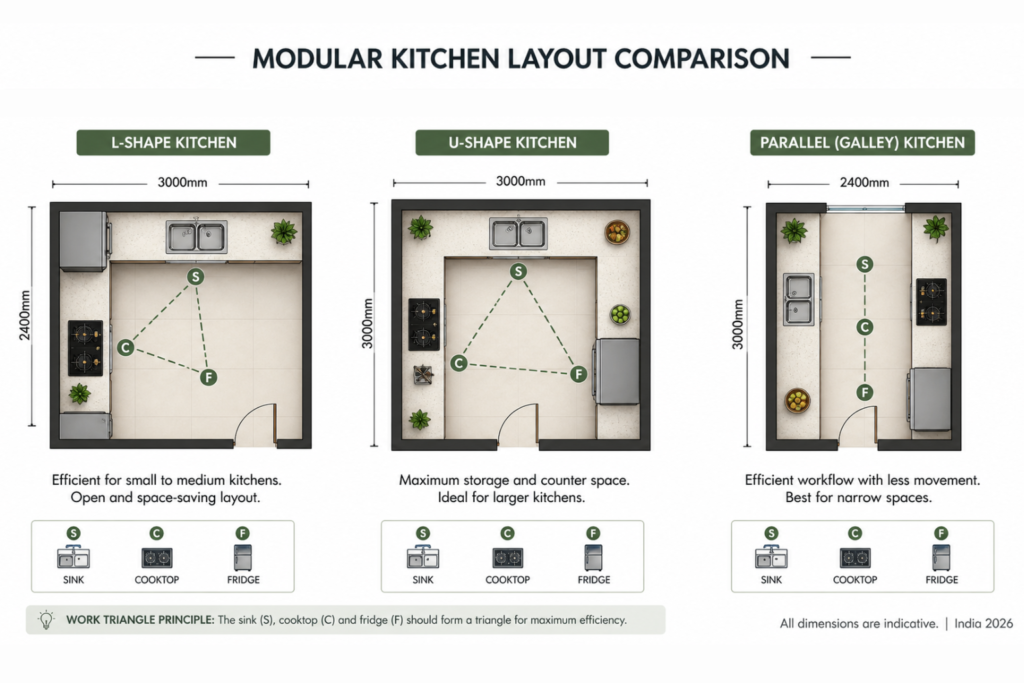
Before comparing layouts, you need to understand the kitchen work triangle, the single most important principle in kitchen design. The work triangle connects your three primary work zones:
- Refrigerator: the storage/retrieval zone
- Sink: the prep and wash zone
- Hob / Cooking Range: the cooking zone
The National Kitchen and Bath Association (NKBA), the global authority on kitchen design, specifies that the ideal work triangle should meet these criteria:
- Each side of the triangle: 4-9 feet
- Total perimeter of all three sides combined: 12-26 feet
- No major traffic path should cross through the triangle
- No full-height obstacle (island, cabinet) should obstruct any side of the triangle
In an Indian context, add a fourth consideration: the spice and masala storage zone, which in a traditional Indian kitchen is accessed dozens of times per cooking session. This should be within arm’s reach of the hob, not at the far end of the counter.
Every layout comparison below is evaluated partly against how well it supports an efficient work triangle for Indian cooking habits.
L-Shape Modular Kitchen: The Most Popular Choice in Indian Homes
What Is an L-Shape Kitchen?
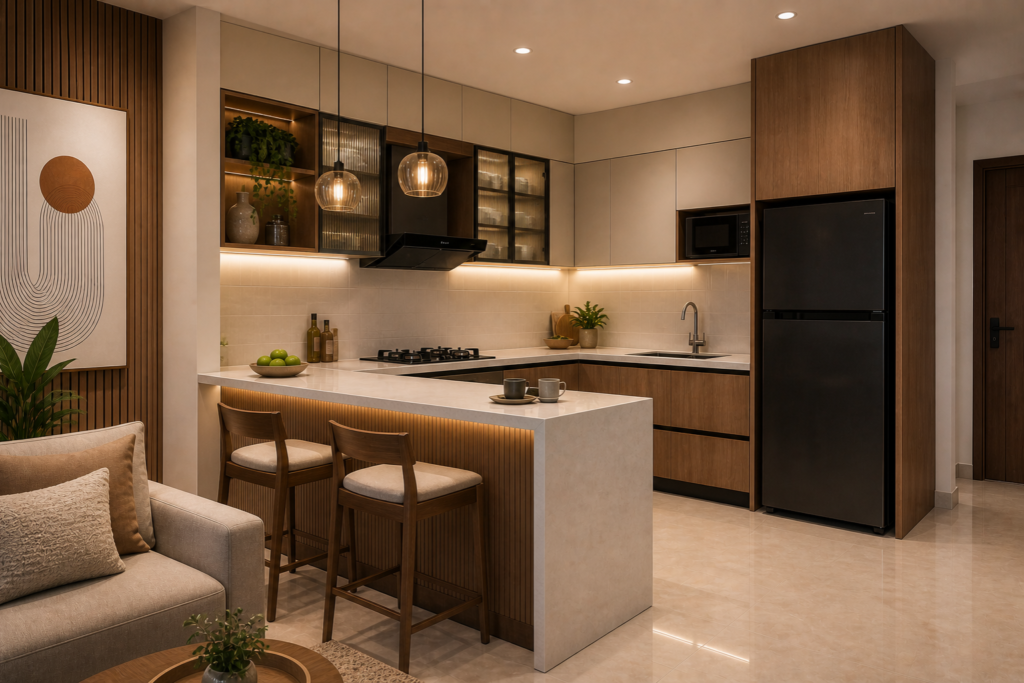
An L-shape kitchen places cabinets and countertops along two adjacent walls that meet at a 90-degree corner, forming the shape of the letter L. It is by far the most common modular kitchen layout in Indian apartments, and for good reason: it is highly adaptable, works in a wide range of room sizes, and naturally supports an efficient work triangle.
Ideal Dimensions
| Dimension | Minimum | Comfortable | Ideal |
|---|---|---|---|
| Longer arm (main counter) | 6 feet | 8 feet | 1012 feet |
| Shorter arm (secondary counter) | 4 feet | 56 feet | 68 feet |
| Aisle width (clearance from counter to wall/unit opposite) | 3 feet | 3.5 feet | 4 feet+ |
| Minimum room area | 70 sq. ft. | 90 sq. ft. | 110140 sq. ft. |
Advantages of L-Shape Modular Kitchen
- Efficient work triangle: hob, sink, and refrigerator sit naturally on two adjacent arms, keeping total triangle distance within the ideal 1222 feet range
- Open dining integration: the open end of the L allows easy visual and physical connection to a dining table or breakfast bar without corridor disruption
- Corner space utilisation: the corner junction can be fitted with a carousel unit (magic corner), a deep blind corner pull-out, or a corner drawer system — converting dead space into accessible storage
- Flexible for multiple cooks: the two arms allow two people to work simultaneously without crossing paths
- Scales well: works in kitchens from 70 to 200+ sq. ft. by adjusting arm lengths
- Natural ventilation placement: in Indian kitchens with a window on one wall, the chimney can be positioned on the longer arm beneath the window for direct exhaust
Disadvantages of L-Shape Modular Kitchen
- Corner units require specialised hardware (carousels, pull-outs) that add cost; a basic corner unit without this becomes an inaccessible dead zone
- For very large kitchens (above 180 sq. ft.), the L-shape may leave the centre of the room empty and under-utilised, and a kitchen island becomes necessary
- Less counter space than a U-shape for the same floor area
Best For
U-Shape Modular Kitchen: Maximum Storage, Maximum Workflow
What Is a U-Shape Kitchen?
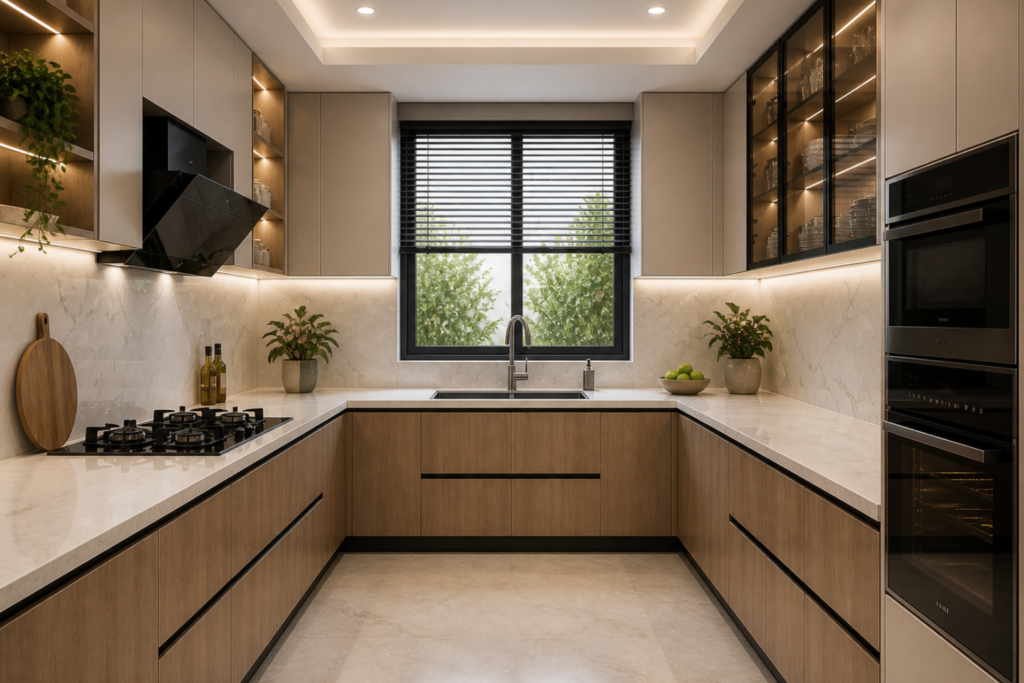
A U-shape kitchen places cabinets and countertops along three walls, forming a U-shape with an open end. It offers the maximum possible counter space and storage within the kitchen footprint, making it the preferred choice for serious home cooks, larger families, and homes where the kitchen is a primary gathering space.
Ideal Dimensions
| Dimension | Minimum | Comfortable | Ideal |
|---|---|---|---|
| Room width (between parallel counter faces) | 8 feet | 9 feet | 10–12 feet |
| Room depth (length of U) | 8 feet | 10 feet | 12–14 feet |
| Central aisle width | 3 feet | 3.5 feet | 4–4.5 feet |
| Minimum room area | 80 sq. ft. | 110 sq. ft. | 130–180 sq. ft. |
Advantages of U-Shape Modular Kitchen
- Maximum counter space: three full walls of counter means more prep area, more storage, and more room for appliances than any other layout
- Multiple work zones: you can dedicate one wall entirely to wet work (sink, dishwasher), one wall to cooking (hob, chimney, oven), and one wall to cold/dry storage (refrigerator, pantry): creating three completely separate zones with zero crossover
- Ideal for Indian cooking: the large counter area accommodates multiple simultaneous tasks: rolling roti, chopping vegetables, and monitoring pots on the hob, all without running out of surface space
- Enclosed and self-contained: the U creates a natural boundary between the kitchen and other spaces, which is helpful for managing cooking smells and noise in an open-plan home
- Two-cook friendly: with clear separation between the three walls, two people can cook simultaneously on completely separate tasks without interfering
Disadvantages of U-Shape Modular Kitchen
- Requires significant floor area: below 8×8 feet, a U-shape becomes a claustrophobic corridor. This rules it out for most 2BHK kitchens in Gurgaon’s mid-range apartments
- Two corner junctions: a U-shape has two internal corners, both of which require specialised carousel or pull-out hardware to be accessible. Without this hardware, two large sections of storage become inaccessible dead zones
- Closed feel: the three-wall enclosure can feel visually heavy in a smaller kitchen. Lighter shutter colours and open upper shelving on one wall can help
- Higher cost: more linear feet of cabinetry plus two corner units means a U-shape kitchen typically costs 30–50% more than an equivalent L-shape
Best For
Parallel (Galley) Modular Kitchen: The Space-Efficient Specialist
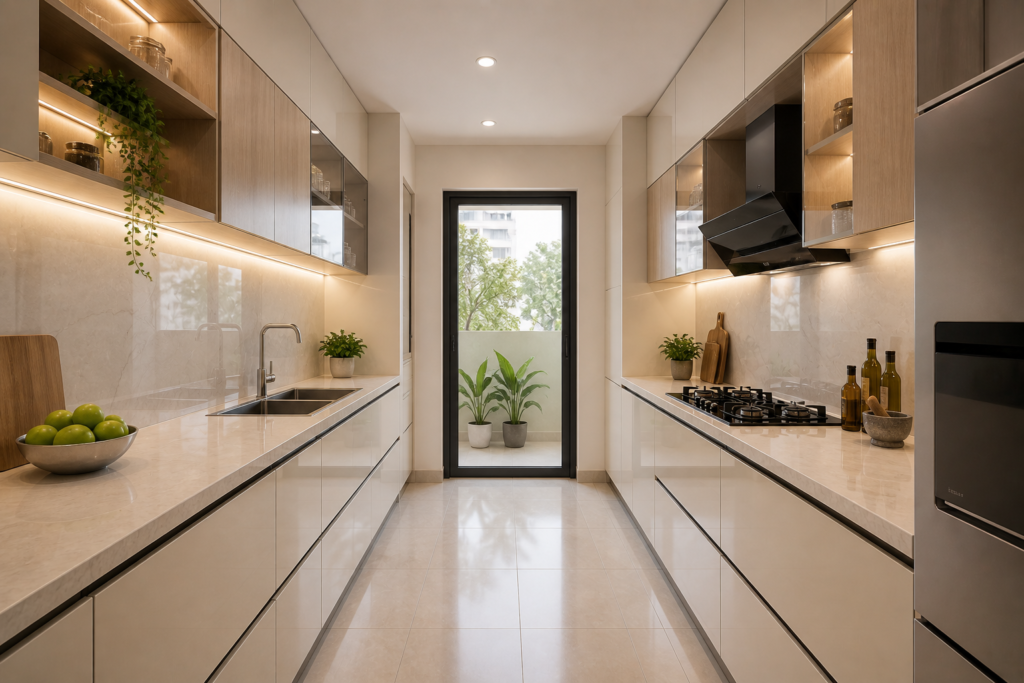
What Is a Parallel / Galley Kitchen?
A parallel kitchen places two counters facing each other on opposite walls, with an aisle running between them. Named after the galley kitchens of ships and aircraft spaces engineered for maximum efficiency in minimum floor area, the parallel layout is the most space-efficient of the three major kitchen types.
Ideal Dimensions
| Dimension | Minimum | Comfortable | Ideal |
|---|---|---|---|
| Room width (wall to wall) | 7 feet | 8 feet | 9-10 feet |
| Room length | 8 feet | 10 feet | 12-16 feet |
| Central aisle (between counter faces) | 3 feet | 3.5 feet | 4 feet |
| Minimum room area | 65 sq. ft. | 85 sq. ft. | 100-130 sq. ft. |
Advantages of a Parallel Kitchen
- Highly efficient single-cook workflow: all surfaces are within a single pivot spin of 180 degrees, and you move from counter to counter. Professional chefs prefer this layout for speed.
- Works in long, narrow rooms, the parallel layout is actually designed for this room shape. A long, narrow kitchen that cannot comfortably accommodate an L- or U-shaped layout becomes highly functional as a parallel kitchen.n
- Clear visual axis, the straight sight line down the aisle makes the kitchen feel longer and more ordered than it is. Light and ventilation travel easily end-to-end.
- No corner units needed without corner junction; there are no carousel or pull-out corner hardware requirements, reducing cost and complexity.
- Zone separation, wet zone (sink, dishwasher) on one wall, dry/cooking zone (hob, oven, prep counter) on the other, completely separate workflows
Disadvantages of a Parallel Kitchen
- Not ideal for multiple cooks, two people working in a parallel kitchen will constantly be crossing paths in the aisle. This is the primary limitation for Indian households, where multi-person cooking is common.
- Dead-end problem: if both ends of the kitchen are closed (no passage), the kitchen becomes a dead-end corridor. Traffic moving through the kitchen from one end to the other disrupts the work zone. Ideally, a parallel kitchen should be open at one or both ends.
- Less dramatic visually compared to an L or U kitchen, a parallel kitchen has less design opportunity for corner accents, island moments, or architectural drama
- Feels narrow at minimum dimensions below 7.5 feet room width, the parallel layout feels claustrophobic,c even with optimal storage and light.
Best For
L-Shape vs U-Shape vs Parallel Complete Comparison Table
| Factor | L-Shape | U-Shape | Parallel |
|---|---|---|---|
| Minimum room area | 70 sq. ft. | 80 sq. ft. | 65 sq. ft. |
| Counter space | Good | Excellent | Good |
| Storage capacity | Good | Best | Moderate |
| Work triangle efficiency | Excellent | Excellent | Good |
| Multiple cooks | Good | Best | Difficult |
| Indian cooking suitability | High | Highest | Moderate |
| Dining integration | Excellent | Limited | Moderate |
| Corner units required | 1 | 2 | 0 |
| Relative cost (same sq. ft.) | Lowest | Highest | Medium |
| Visual drama/design appeal | High | Very High | Moderate |
| Best room shape | Square / slightly rectangular | Square/wide | Long and narrow |
Materials: Shutters, Countertops, Hardware Explained
The layout decision determines the structure of your kitchen. The materials determine the quality, durability, and aesthetics. Here is what you need to know about the three most critical material choices in a modular kitchen.
Cabinet Carcass (Box) Material
| Material | Durability | Moisture Resistance | Cost |
|---|---|---|---|
| BWP/Marine Plywood (IS:710) | Highest | Highest | Highest |
| HDMR (High Density Moisture Resistant) | High | High | Medium |
| MR MDF | Medium | Medium | Lower |
| Particle Board / HDF | Low | Low | Lowest |
Our recommendation: In Indian kitchens where steam, heat, and moisture are daily realities, always use HDMR or BWP plywood for the carcass, regardless of your budget tier. Saving money on carcass material to upgrade shutter finish is a trade-off that rarely pays off over time.
Shutter Finishes
- Laminate (flat/textured): Most durable, widest colour range, easiest to clean, most economical. Our go-to choice for budget and mid-range projects.
- Acrylic (glossy): Mirror-finish, modern aesthetic, shows fingerprints, susceptible to fine scratches over time. Popular in premium apartments.
- PU (Polyurethane) Paint: Smooth painted finish, softest tactile quality, available in any RAL colour, slightly higher cost than laminate.
- Membrane/Thermofoil: Wraps the MDF in a seamless film, with routed profiles and curved edges possible. Good for contemporary profiles.
- Veneer: Real wood appearance, warm texture, premium cost. Best for accent sections (an island or one wall panel) rather than the entire kitchen.
Countertop Materials
- Quartz (engineered stone): Best all-round countertop stain-resistant, heat-resistant, non-porous, consistent appearance. ₹250–₹600 per sq. ft. Our top recommendation for Indian kitchens.
- Granite: Extremely durable and heat-resistant. Natural variation in pattern. ₹150–₹350 per sq. ft. Excellent for Indian cooking with heavy vessels and hot pans.
- Ceramic / Vitrified tile: Most economical, easy to replace individual tiles, good heat resistance. Grout lines are harder to keep clean and not ideal for a food prep zone.
- Corian / Solid Surface: Seamless, repairable, no grout lines. Mid-to-high cost. Not as heat-resistant as stone, use trivets near the hob.
- Natural marble: Beautiful but high maintenance, porous, stains easily, and etches with acids (lemon, vinegar). Not recommended for an Indian kitchen unless sealed and maintained regularly.
Modular Kitchen Cost in India 2026: Complete Breakdown
| Kitchen Type | Budget | Mid-Range | Premium |
|---|---|---|---|
| L-Shape (10 ft running) | ₹1.5-₹2.2L | ₹2.5-₹4L | ₹4.5-₹8L |
| U-Shape (16 ft running) | ₹2.5-₹3.5L | ₹4-₹6.5L | ₹7-₹12L+ |
| Parallel (12 ft running) | ₹1.8-₹2.8L | ₹3-₹5L | ₹5.5-₹9L |
| Chimney (60cm) | ₹8,000-₹18,000 | ₹20,000-₹40,000 | ₹45,000-₹1L+ |
| Sink (SS undermount) | ₹3,000-₹8,000 | ₹8,000-₹20,000 | ₹20,000-₹50,000 |
| Backsplash tiling | ₹40-₹80/sq.ft. | ₹80-₹180/sq.ft. | ₹180-₹500+/sq.ft. |
| Installation (Delhi NCR) | Included | Included | Included |
Cost tip: The single biggest cost variable in a modular kitchen is not the layout; it is the shutter finish and countertop material. A U-shape kitchen with laminate shutters and a granite countertop can cost less than an L-shape with PU paint shutters and quartz. Define your countertop choice first; that single item can swing your total budget by ₹50,000–₹2,00,000.
Which Layout Is Best for Indian Cooking? An Honest Answer
Indian cooking is the most demanding domestic cooking style in the world by virtually every measurable parameter, including the number of burners used simultaneously, volume of oil and spice handling, heat intensity, steam and smoke generation, vessel weight, and frequency of kitchen use. A kitchen designed for European or American cooking habits will be frustrating for an Indian household within weeks.
Here is our honest ranking for Indian cooking specifically:
1st: U-Shape. If your kitchen space allows it (above 100 sq. ft., room width of 9 feet+), the U-shape is the best layout for Indian cooking. The three-wall system allows complete zone separation: wet work (sink, prep), dry prep (masala, cutting), and hot work (hob, oven) can each occupy a dedicated wall with no crossover. Counter space for rolling, kneading, and multiple simultaneous prep tasks is unmatched.
2nd: L-Shape. For the majority of Indian 2BHK and 3BHK apartment kitchens, the L-shape is the right choice. It handles Indian cooking well, particularly when the longer arm (8–10 feet) is dedicated to wet and prep work, and the shorter arm (5–6 feet) houses the hob and chimney. The open end of the L allows easy connection to a dining or breakfast area.
3rd: Parallel Adequate for single-cook households but challenging for the multi-person cooking that is common in Indian families. The aisle becomes a conflict zone when two people are cooking simultaneously. The parallel kitchen works best in households with lighter cooking demands or in homes where a helper does standalone prep while the primary cook handles the hob.
For context on how kitchen design fits into the broader interior plan of an Indian home, see our guide to small flat interior design ideas for a 2BHK in Gurgaon, which covers the kitchen, living room, and bedroom in the context of a compact apartment. For insights on how our architects approach residential design holistically, visit our low-rise residential architecture page.
6 Common Modular Kitchen Mistakes in Indian Homes
Mistake 1: Not Planning Appliance Locations Before Cabinetry
Refrigerator, microwave, oven, dishwasher, water purifier, mixer-grinder, and toaster. The electrical points, plumbing connections, and ventilation requirements for all of these must be confirmed before the cabinet design is finalised. Adding an appliance after cabinetry is installed means sawing through finished work. Plan every appliance first.
Mistake 2: Choosing Shutters for Looks Without Considering Maintenance
High-gloss acrylic shutters look spectacular in showrooms. In a working Indian kitchen, with daily cooking, greasy fingers, and condensation from boiling pots, they show every fingerprint and are permanently micro-scratched within a year. Textured laminate or matte PU finishes require significantly less maintenance and look better for longer in the Indian kitchen environment.
Mistake 3: Under-specifying the Chimney
The chimney is the most underinvested appliance in Indian kitchens. A chimney that is too small in extraction capacity (below 1,000 m³/hr for a standard 4-burner hob with heavy Indian cooking) will constantly recirculate grease and odour rather than extracting them. Buy the chimney before finalising the kitchen layout, its width and position determine the entire cooking wall configuration.
Mistake 4: No Dedicated Masala / Spice Storage
This is the most uniquely Indian kitchen design failure. European kitchen design places spices in a rack or a single drawer. An Indian kitchen requires dedicated, deep, accessible storage for 30–50 spice containers, dals, grains, and condiment bottles within reach of the hob without bending or stretching. A tandem drawer unit or a pull-out spice tower next to the hob solves this. It is not an optional accessory; it is a necessity.
Mistake 5: Ignoring the Wet Waste and Dustbin Zone
Indian meal prep generates significant wet waste, such as vegetable peels, used masala water, and leftover dal. A built-in pull-out dustbin unit with separate compartments for wet and dry waste, positioned under or adjacent to the sink, is one of the most-used features in a well-designed kitchen. Most budget kitchens skip this entirely, which means a standalone bin sitting on the floor is unhygienic and inconvenient.
Mistake 6: Buying Modular Without Professional Design Input
Many homeowners in Gurgaon purchase modular kitchens directly from branded showrooms (Sleek, Hettich, Godrej Interio, IKEA) without involving an interior designer. The showroom salesperson will sell you a kitchen that fits your room dimensions. What they will not do is optimise the work triangle for your cooking habits, coordinate the kitchen design with your flooring and ceiling plans, or ensure the electrical and plumbing are in the right positions before installation begins. Our interior design team in Gurgaon coordinates the full kitchen design layout, materials, appliances, electrical, and civil preparation before a single cabinet is ordered.
Frequently Asked Questions: Modular Kitchen Design
Plan Your Modular Kitchen with Studio Rivet
We design modular kitchens as part of a complete home interior layout, materials, appliances, lighting, and civil coordination handled together. Based in DLF Phase 1, Gurugram. Serving Delhi NCR since 2005.
📍 49 Arjun Marg, DLF Phase 1, Sector 26, Gurugram – 122002
📞 +91 9971685572 | 📞 +91 9818491069 | ✉️ info@studiorivet.in
Written by Studio Rivet
Studio Rivet is an architecture and interior design studio based at 49 Arjun Marg, DLF Phase 1, Gurugram. Founded in 2005, we work on residential, commercial, hospitality, and institutional projects across Delhi NCR. Learn more about us →

From Concept to Construction: The Journey of a Visionary Architectural Design
Architectural projects begin with an idea. Sometimes it comes from a client’s need, sometimes from

High-Rise vs Low-Rise Housing in India: Which One Is Right for You?
Every year, thousands of families across Gurgaon, Delhi, Mumbai, Bengaluru, and Pune face this exact

Vastu Shastra Friendly Interior Design Ideas for Modern Homes
Designing a modern home today goes far beyond aesthetics. Homeowners are increasingly looking for sp
Leave a Reply