



False ceiling design ideas for indian living rooms 2026
The false ceiling design for living room is no longer a luxury reserved for premium homes. In 2026, it has become one of the most cost-effective ways to transform any Indian living room, adding drama, hiding wiring, improving acoustics, and creating the kind of layered lighting that makes a space feel designed rather than simply furnished.
Whether you live in a compact 2BHK in Gurgaon, a builder floor in Delhi, or a villa in DLF Phase 1, the right false ceiling can change the entire character of your living room. This guide covers every type, every material, real 2026 costs, and expert tips from Studio Rivet, an architecture and interior design studio based in DLF Phase 1, Gurugram.
Quick Facts – False Ceilings in India 2026
- Indian false ceiling market projected to grow at 7.8% CAGR through 2028 (source: IBEF Construction Report)
- Gypsum board is the #1 preferred material for residential ceilings in NCR
- Cove lighting and false ceilings increase perceived room size by 15-20% in small spaces
- Average false ceiling cost in India in 2026: ₹80-₹450 per sq. ft., depending on material
- Installation time for a 300 sq. ft. living room: 3-5 days
In This Article
- Why a False Ceiling Is Worth It in 2026
- 7 Types of False Ceilings for Indian Living Rooms
- 10 Best False Ceiling Design Ideas (With Visuals)
- Lighting Combinations That Work
- False Ceiling Cost in India 2026
- 5 Mistakes to Avoid
- False Ceiling Design in Gurgaon — What’s Trending
- Frequently Asked Questions
Why a False Ceiling Is Worth It in Your Indian Living Room
A well-designed false ceiling does four things simultaneously that no other single interior element can match:
1. It creates lighting layers: The biggest visual upgrade you can make to any Indian living room is moving from a single central light fixture to layered lighting, ambient, task, and accent. A false ceiling is the structure that makes this possible. Cove lighting, recessed spots, pendant drops through cutouts, none of this is achievable without a ceiling framework.
2. It hides the mess: Most Indian apartments have exposed wiring conduits, AC ducts, POP patches, and uneven concrete slab surfaces. A false ceiling conceals all of this behind a clean, painted surface. The difference in visual quality is immediate and significant.
3. It improves acoustics: Gypsum and mineral fibre false ceilings absorb sound and reduce echo, especially important in open-plan living rooms with hard flooring. For homes in Gurgaon’s high-density developments, this makes a real difference to daily comfort.
4. It adds thermal comfort: A false ceiling creates an air gap between the living space and the concrete slab, reducing heat transfer in Delhi NCR’s intense summer climate. Rooms with false ceilings cool down faster and maintain temperature more consistently.
Our interior design team in Gurgaon includes a false ceiling plan in virtually every residential project we take on; it is foundational to the finished quality of the space.
7 Types of False Ceilings for Indian Living Rooms
Choosing the right material is the first decision. Each type has different strengths, costs, and visual outcomes. Here is a clear comparison.
| Material | Best For | Cost (per sq. ft.) | Durability | Moisture Resistant |
|---|---|---|---|---|
| Gypsum Board | All room types – most versatile | ₹120-₹200 | High | Moderate (use moisture-resistant grade in humid areas) |
| POP (Plaster of Paris) | Budget projects, ornate designs | ₹80-₹150 | Medium | Low (cracks over time) |
| Mineral Fibre Tiles | Offices, institutional spaces | ₹90-₹160 | High | High |
| Wooden / Veneer Panels | Premium living rooms, accent zones | ₹280-₹600 | High | Low (not for wet areas) |
| Metal (Aluminium / GI) | Modern/industrial look | ₹200-₹450 | Very High | Very High |
| Stretched Fabric / PVC | Backlighting effects, luxury homes | ₹350-₹800 | Medium | High |
| Combination (Multi-material) | High-end residential, custom design | ₹300-₹700+ | Very High | Depends on the materials chosen |
Note: Costs above are for supply and installation in Delhi NCR (Gurgaon, Delhi, Noida) as of 2026. Prices vary by project size, ceiling height, and complexity.
10 Best False Ceiling Design Ideas for Indian Living Rooms in 2026
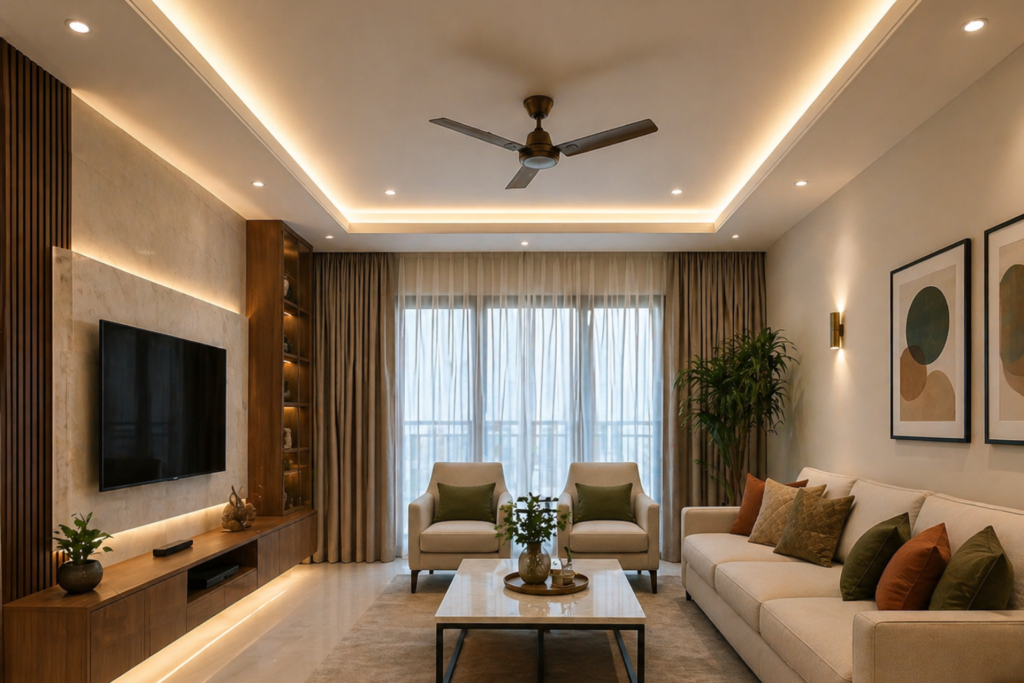
1. Classic Cove Ceiling: The Most Popular Choice in 2026
The cove ceiling remains the single most popular false ceiling design for Indian living rooms in 2026 and for good reason. A cove is created by installing a perimeter border that steps down from the full ceiling height, with LED strip lighting hidden in the recess. The result is a warm, continuous glow that reflects off the ceiling and fills the room with indirect ambient light.
Why it works for Indian homes: The cove design is culturally neutral; it works equally well in a traditional home with wooden furniture and in a minimalist flat with clean-lined sofas. It does not impose a style; it elevates whatever style you already have.
Best for: All living room sizes. For small rooms, keep the step shallow (4-6 inches). For larger rooms, a double-step cove creates more drama.
Material: Gypsum board with moisture-resistant primer and LED RGBW strip lighting (warm white 2700-3000K for most living rooms).
2. Coffered Ceiling: Adds Architecture to a Flat Slab
A coffered ceiling creates a grid of recessed panels, like a waffle pattern, that adds enormous visual richness to a plain concrete slab. In India, coffered ceilings have traditionally been associated with Mughal and colonial architecture. In 2026, the coffered ceiling is experiencing a revival in contemporary form, shallow, clean-edged coffers with recessed LED strips inside each panel rather than classical mouldings.
Best for: Large living rooms (300+ sq. ft.) with ceiling heights above 3m. Not recommended for rooms with slabs below 2.9m, the depth of the coffers will make the room feel low.
Material: Gypsum board for most residential projects. Wooden or MDF frame with veneer finish for a premium version.
3. Tray Ceiling: The Elegant Two-Level Design
A tray ceiling steps up in the centre, and the middle section sits higher than the perimeter border. This creates a sense of height and spaciousness even in relatively modest rooms. The step between the two levels is where lighting, wallpaper, or a contrasting paint colour is introduced.
Popular variant in Gurgaon homes: A white gypsum tray ceiling with a warm-toned wallpaper or textured paint applied inside the tray (the upper recessed area), and cove LED lighting at the junction of the two levels. This adds depth and colour without the expense of feature walls.
Best for: Living rooms of all sizes. Particularly effective in 2BHK and 3BHK apartments where the slab height is 2.75m+, the tray effect makes the room feel significantly taller. If you want to learn more about maximising space in compact homes, read our guide to small flat interior design ideas for a 2BHK in Gurgaon.
4. Grid / Geometric Ceiling: The Contemporary Statement
In 2026, geometric false ceilings are trending strongly in Delhi NCR’s premium residential market. These use straight-line gypsum or MDF channels to create a grid, hexagonal, or custom geometric pattern on the ceiling surface. Recessed lights sit within the grid, and the channels themselves can be painted a contrasting colour or finished in metal-look laminate.
The appeal: A geometric ceiling is unmistakably contemporary and photographs exceptionally well, increasingly important for homeowners who want their space to reflect a distinct design identity.
Best for: Modern homes, apartments in Golf Course Extension, DLF Phase 5, and Cyber City-adjacent areas where clients have a globally influenced aesthetic.
5. Wooden Panel Ceiling: Warmth and Texture
A partial or full wooden panel ceiling introduces texture and warmth that no painted surface can replicate. In Indian living rooms, where the tendency is towards warm, rich interiors, a wooden ceiling creates an immediate sense of comfort and quality.
Practical approach: Rather than solid wood (heavy, expensive, prone to warping in India’s humidity), use engineered wood panels with teak, walnut, or oak veneer. These are lighter, more dimensionally stable, and much more affordable than solid wood.
Design tip: Use wooden panels only on a portion of the ceiling, typically the central section above the main seating area, and keep the perimeter in gypsum with cove lighting. This hybrid approach gives the warmth of wood without the cost or weight of a full timber ceiling.
6. Stretch Fabric / Backlit Ceiling: For Maximum Drama
A stretch fabric ceiling uses a tensioned PVC membrane that, when backlit with LED panels, creates the appearance of a glowing sky or a seamless luminous surface. These are spectacular in larger living rooms and hospitality spaces, and are increasingly being used in premium residences in Gurgaon.
Best for: Living rooms above 400 sq. ft. in villas or high-floor apartments. The effect is most powerful when the room receives limited natural light.
Cost range: ₹350-₹800 per sq. ft. This is one of the more expensive options, but it creates an effect that no other ceiling type can match.
7. False Beam Ceiling: Rustic or Contemporary
Exposed beams, whether real or simulated, add structural character to a ceiling. In 2026 Indian interior design, the false beam is appearing in two distinct styles: the traditional heavy wooden beam (popular in farmhouse-style homes in NCR’s peripheral areas) and the contemporary slim metal or painted MDF beam in white or dark grey (popular in urban apartments with an industrial or loft aesthetic).
Note: False beams add height perception; they draw the eye upward along their length, making a room with a modest ceiling height feel taller.
8. Perimeter-Only (Floating) Ceiling: Best for Small Rooms
For rooms with a slab height of 2.7m or less, a full false ceiling will reduce the height to a point that feels cramped. The perimeter-only ceiling, a 2-3 foot border of gypsum around the edge of the room with cove lighting, is the ideal solution. The centre of the ceiling remains at full height, and the cove lighting creates the same ambient glow as a full ceiling design at a fraction of the cost and without reducing the room’s height perception.
This is one of our most recommended solutions for interior design projects in Gurgaon’s 2BHK and 3BHK apartments.
9. Dome / Curved Ceiling: The Focal Point
A dome or curved ceiling element, typically created in POP or custom-moulded gypsum, creates a visual focal point above the seating area. This is a traditional element in South Indian and Rajasthani architecture that is being reinterpreted in contemporary form in 2026.
Contemporary version: A shallow oval or elliptical recess in the centre of the ceiling, finished in a contrasting colour or with a concealed ring of LED lighting, creates the sculptural focus of a dome without the weight or visual heaviness of a traditional design.
10. Multi-Level Combination Ceiling: The Studio Rivet Approach
The most sophisticated false ceiling designs combine multiple elements, a tray at the centre, cove lighting at the perimeter, a wooden panel in one section, and recessed spots throughout, to create a ceiling that is as carefully designed as any other element of the room.
At Studio Rivet, we design multi-level ceilings in which every layer has a purpose: the cove defines the room boundary, the central tray adds perceived height, the wooden panel introduces material warmth, and the recessed lights deliver precisely placed task and accent illumination.
This approach requires careful planning from the beginning; the ceiling layout must be coordinated with the furniture plan, the wall treatment, and the electrical layout. It cannot be designed in isolation.
Lighting Combinations That Make a False Ceiling Extraordinary
The ceiling design and the lighting plan are inseparable. A beautifully detailed false ceiling with poor lighting is a wasted investment. Here are the combinations that consistently deliver the best results in Indian living rooms.
| Lighting Type | Placement | Colour Temp | Effect |
|---|---|---|---|
| LED Cove Strip | Hidden in a cove recess, facing upward | 2700-3000K (warm white) | Soft ambient glow enlarges perceived room size |
| Recessed Downlights | Main ceiling panel, over seating | 3000-4000K | Task + ambient, primary illumination |
| Pendant / Chandelier Drop | Through a cutout in the false ceiling | 2200-2700K | The focal point adds personality and height perception |
| Accent Spotlights | Aimed at artwork, plants, and feature walls | 2700-3000K | Highlights, depth, drama |
| RGBW Smart Strip | Cove + behind panels | Variable (app-controlled) | Mood lighting, colour-changing for festive occasions |
Pro tip: Always run cove lighting and downlights on separate switch circuits (or smart dimmer zones). Being able to dim the downlights and run only the cove in the evening transforms the same room into two entirely different experiences, one for daily use and one for entertaining.
False Ceiling Cost in India 2026, Complete Breakdown
Understanding the cost structure prevents unpleasant surprises. Here is a complete breakdown of what you will pay for a false ceiling project in Delhi NCR (Gurgaon, Delhi, Noida, Faridabad) in 2026.
| Item | Budget Range | Mid Range | Premium |
|---|---|---|---|
| POP False Ceiling (per sq. ft.) | ₹80-₹110 | ₹110-₹150 | ₹150-₹200 |
| Gypsum Board Ceiling (per sq. ft.) | ₹120-₹150 | ₹150-₹200 | ₹200-₹280 |
| Wooden Panel Ceiling (per sq. ft.) | ₹280-₹350 | ₹350-₹500 | ₹500-₹700+ |
| LED Cove Lighting (per running ft.) | ₹50-₹80 | ₹80-₹120 | ₹120-₹200 |
| Recessed Downlights (each, installed) | ₹300-₹600 | ₹600-₹1,200 | ₹1,200-₹3,000 |
| Painting (per sq. ft.) | ₹12-₹18 | ₹18-₹28 | ₹28-₹45 |
| Typical 300 sq. ft. Living Room, Total | ₹35,000-₹55,000 | ₹60,000-₹1,00,000 | ₹1,10,000-₹2,50,000+ |
Cost-saving tip: The biggest cost reduction in a false ceiling project comes from scope, not material grade. A full gypsum ceiling with basic paint and standard LED strips in a 300 sq. ft. room will cost approximately ₹60,000-₹75,000. A perimeter-only cove in the same room will cost ₹25,000-₹35,000 and achieve 80% of the visual effect at 40% of the cost. Always ask your designer to show you the perimeter-only option before committing to a full ceiling design.
5 Common False Ceiling Mistakes in Indian Living Rooms
These are the mistakes our interior design team in Gurgaon sees most often, and each one is completely avoidable with early planning.
Mistake 1: Doing the Ceiling Without an Electrical Plan
The ceiling and the electrical layout must be designed together. If you finalise your furniture plan first, then finalise the ceiling, and then ask the electrician to run wires, you will end up with downlights in the wrong positions and junction boxes showing in the wrong places. Plan ceiling, lighting, and furniture simultaneously before any civil work begins.
Mistake 2, Reducing Height Too Much in Small Rooms
A full false ceiling in a room with a 2.7m slab brings the finished height down to approximately 2.45m. This is technically within building bylaw minimums in India, but it feels noticeably low. The BIS standard for habitable rooms (as per NBC 2016) recommends a minimum height of 2.75m for naturally ventilated rooms. In any room with a slab height below 2.85m, use a perimeter-only or partial false ceiling.
Mistake 3, Using Cold White LEDs (6000K+)
Cold white LEDs (above 5000K) are appropriate for workspaces and hospitals, not living rooms. In an Indian living room, where a warm, welcoming ambiance is the goal, always use warm white (2700-3200K) for cove and ambient lighting. Neutral white (4000K) can be used for task areas if required.
Mistake 4, Skipping the Dimmer
A false ceiling with beautiful cove lighting that cannot be dimmed is a significant missed opportunity. Smart dimmers cost ₹1,500-₹4,000 per circuit and transform the room’s usability across different times of day and different occasions. Always specify dimmers for cove and pendant circuits.
Mistake 5: Choosing Design Before Choosing the Designer
Many homeowners arrive at a false ceiling project with a Pinterest board of designs they love, which is fine, but commit to a specific design before their interior designer has had a chance to analyse the room’s proportions, slab height, furniture layout, and natural light. The best false ceiling design for your room is one that is developed specifically for your space, not copied from a reference image. Our interior design studio in Gurgaon always begins with a site analysis before presenting ceiling design options.
False Ceiling Trends in Gurgaon and Delhi NCR, 2026
The Gurgaon residential market in 2026 is showing three clear false ceiling trends that differ slightly from the national picture.
Trend 1, Minimal, plaster-free ceilings in Golf Course Extension. In the premium segment, Golf Course Extension Road, Nirvana Country, Sector 65, the aesthetic is moving away from ornate POP mouldings and towards clean, seamless gypsum with no visible joints, no mouldings, and light from carefully placed recessed apertures. The ceiling disappears; the light is the design.
Trend 2, Warm materials in DLF Phase 1 and Sushant Lok. In DLF Phase 1 and the established residential sectors of Gurgaon, the preference is for warmth, partial wooden panel ceilings, amber-tone cove lighting, and tray ceilings with textured paint inside the tray. These homes tend to have larger floor plates and higher slabs, giving designers more freedom to layer materials.
Trend 3, Smart lighting integration in new-build apartments. New residential projects on Dwarka Expressway and along NH-48 are being designed with smart home integration from the outset. False ceiling designs in these homes incorporate Philips Hue, Lutron, or similar smart lighting systems, RGBW LED strips, colour-tunable downlights, and voice or app control. For a deeper look at how architecture influences these spaces, see our post on the top residential architects in DLF Phase 1, Gurgaon.
For Vastu-conscious homeowners, false ceiling design can be planned to complement directional principles, keeping the Brahmasthan (central zone) lighter and more open, and using heavier materials towards the south and west. See our detailed guide on Vastu-friendly interior design ideas for modern homes.
Frequently Asked Questions
Plan Your False Ceiling Design with Studio Rivet
We design false ceilings as part of a complete interior plan, coordinated with your furniture, lighting, flooring, and wall treatment. Based in DLF Phase 1, Gurugram. Serving Delhi NCR since 2005.
📍 49 Arjun Marg, DLF Phase 1, Sector 26, Gurugram, 122002
📞 +91 9971685572 | 📞 +91 9818491069 | ✉️ info@studiorivet.in
Related Articles
Small Flat Interior Design Ideas for 2BHK in Gurgaon
Space-saving design tips for compact apartments in Delhi NCR
Best Interior Designers in Gurgaon 2026: What to Look For
A complete guide to hiring the right design studio in Gurugram
Vastu Shastra Friendly Interior Design Ideas for Modern Homes
How to integrate Vastu principles without compromising on design
Written by Studio Rivet
Studio Rivet is an architecture and interior design studio based at 49 Arjun Marg, DLF Phase 1, Gurugram. Founded in 2005, we work on residential, commercial, hospitality, and institutional projects across Delhi NCR. Learn more about us →

Best Wall Colours for Homes (Room by Room Guide)
Paint is the cheapest and fastest way to change how your home feels, yet it is the one decision peop

Modern Mirror Wall Ideas to Make Any Room Look Bigger
Few design features change a room as quickly as a mirror. Add a well-placed mirrored surface and a s

Best Interior Designers in Gurgaon 2026: What to Look For
Choosing the right interior designers in Gurgaon is one of the most important decisions you will mak
Leave a Reply